Photodynamic Therapy for Acne
Photodynamic Therapy for Acne
Ann-Marie Wennberg Larkö Department of Dermatology and Venereology, Institute of Clinical Sciences, Sahlgrenska Academy, University of Gothenburg, 413 45 Gothenburg, Sweden
Abstract
Acne is a common disease that affects a large part of the young population. Common treatments for moderate acne include the use of oral antibiotics. However, there is an increased risk of antibiotic resistance. Furthermore, the environmental effects of these drugs may be severe. Hence there is an alternative for treatment of moderate acne. Photodynamic therapy (PDT) seems to have a good effect. However, treatment parameters need to be elaborated upon as possibly the choice of photosensitizer in the future. Pain is a cumbersome side effect but may be controlled by easy measures.
Keywords AcneAntibioticsPhotodynamic therapyBacterial resistanceEnvironmental hazards
Introduction
Acne is a common skin disorder affecting mainly adolescents but also adults. Comedones become inflamed and sometimes cystic acne appears. Acne leads to severe suffering at a sensitive age. Patients with acne have a higher unemployment rate compared to the person with a healthy skin (Cunliffe 1986). There is no generally accepted grading system for acne. However, in clinical practice this is less of a problem.
Moderate to severe acne is often treated with systemic antibiotics, especially tetracyclines. This may lead to bacterial resistance and have impact on environmental issues as tetracyclines do not degrade easily in nature. There seems to be an association between bacterial resistance and poor treatment results (Thiboutot 2011).
Relevant Etiology
The pilosebaceous unit is the target organ. The secretion of sebum is increased, and P. acnes produces lipase that degrades triglycerides to glycerol and fatty acids which have inflammatory properties. P. acnes also excretes porphyrins which are light sensitive. Hence, visible light and photodynamic therapy can induce a photochemical reaction and less P. acnes (Hongcharu et al. 2000). However, this has been debated (Guffey and Wilborn 2006).
Photodynamic Therapy (PDT)
The basic principle is that a photosensitizer is concentrating in rapidly proliferating cells. The sensitizer is then converted to light-sensitive porphyrins. When exposed to light, a photochemical reaction occurs together with oxygen via energy transfer producing singlet oxygen. Hence, free radicals are formed and cell death occurs (Dougherty et al. 1978).
The most common photosensitizer used is delta-aminolevulinic acid (ALA). Several other derivatives are also used or tried (Song et al. 2014). See below.
ALA and its derivatives are mainly used for treating skin cancer or its precursors, actinic keratosis, superficial basal cell carcinoma, and squamous cell skin cancer in situ. Clinical results are good for thin lesions, but thicker tumors are harder to treat, e.g., nodular basal cell carcinomas (Sandberg et al. 2008).
The methyl ester of ALA (MAL) is probably most often used today. MAL is deesterified to ALA. MAL is more lipophilic than ALA and suggested to be more selective. However, it is questionable if there is a significant difference in transdermal penetration between ALA and MAL. Recently, a new formulation was introduced, BF-200. It may be more effective than ALA in tumor treatment (Neittaanmaki-Perttu et al. 2014).
The rate-limiting steps in heme formation are ALA synthetase and ferrochelatase. Exogenous application of ALA bypasses the first rate-limiting enzyme. Accordingly, accumulation of protoporphyrin IX (PpIX) takes place as ferrochelatase probably is downregulated. This process occurs in sebocytes. It seems that the intracellular target is the mitochondria (Peng et al. 1992). The process is oxygen dependent and oxygen depletion leads to less tissue damage (Ericson et al. 2003).
Mechanism of Action in Acne
P. acnes itself produces small amounts of porphyrins (Romiti et al. 2000). This can be seen as fluorescence when irradiating a skin area with UVA. Irradiation with blue or red light leads to excitation of the endogenously produced porphyrins and formation of singlet oxygen. This results in bacterial death.
Applying ALA or its derivatives leads to formation of PpIX and accumulation in sebocytes. Again, singlet oxygen is formed in the presence of oxygen and the sebocytes are affected. In some studies sebum production has decreased, and in other studies this has not been found (Hongcharu et al. 2000; Horfelt et al. 2007).
More than 15 years ago, PDT treatment of acne was discussed (Hongcharu et al. 2000). They reported good effects of PDT for acne and showed a decreased sebum excretion due to damaged sebaceous glands. Others have not found a reduced sebum excretion (Horfelt et al. 2007; Pollock et al. 2004). Mouse studies have also indicated that ALA is taken up by sebaceous glands preferentially (Divaris et al. 1990).
Red light has a better tissue penetration than blue light or UV. Red light has been suggested to have anti-inflammatory properties on acne as well (Na and Suh 2007).
Blue light seems to be the most effective wavelength in photoactivating P. acnes. It seems that blue light alone may be beneficial against acne (Morton et al. 2005). Red and blue light might also be combined (Papageorgiou et al. 2000).
Jeong et al. have demonstrated that topical ALA-PDT for acne can induce apoptosis of sebocytes (Jeong et al. 2011).
Kosaka et al. demonstrated that focused damage of sebaceous glands may be achieved with ALA-PDT (Kosaka et al. 2011).
Light Sources for PDT
Both lasers and noncoherent light sources may be used (Zheng et al. 2014). The advantage of noncoherent light sources is that they are cheap and simple. However, LED light sources have become more common in everyday life and extremely cheap as pointers, LED lighting at home, headlights for cars etc. Unfortunately, LED light sources for treatment are rather expensive for various reasons. One can argue in favor of broadband light sources but also against. One advantage is that a bigger part of the absorption spectrum is used, one disadvantage that they produce more heat.
Lasers produce coherent, monochromatic light which exactly can match the absorption spectrum of porphyrins. The irradiated area is usually small which is a disadvantage. Also, the special properties of laser radiation, e.g., coherency, are not necessary.
Exposure to different wavelengths has been claimed to have a beneficial effect (Sadick 2009). The effect of sunlight is probably due to bacterial destruction as well as immunosuppression by its effect on Langerhans cells. It is probably mainly the UVA portion that is active. UVB has a poorer penetration in tissue and does not match the absorption band of porphyrins.
Visible light alone has proved to have an effect on acne (Sigurdsson et al. 1997).
Clinical Results
Several authors have reported good results after ALA-PDT for acne (Hongcharu et al. 2000; Horfelt et al. 2007).
Recently, a new LED device was introduced with green and red light (Dong et al. 2015). The overall effectiveness rate was 90% in 46 patients with moderate to severe acne. They argue that pulsed light sources may be less effective as there is not sufficient oxygen. Using shorter wavelengths may decrease pain.
Ying et al. recently published good results after PDT treatment of acne. They used 5% ALA in 21 patients with severe acne and a LED light source emitting at 633 nm. Total effectiveness rate was 85%.
Japanese studies have demonstrated a good effect of PDT on acne, but broadband light sources may cause more pain (Asayama-Kosaka et al. 2014).
Recently Das and Reynolds have discussed advances in acne pathogenesis and implications for therapy (Das 2014). They discuss different wavelengths and different light sources. Infrared lasers may minimize the sebaceous glands or affect lipids (Das and Reynolds 2014).
Both visible light and ALA have been proven to have an effect on acne. Pinto et al. compared the efficacy of red light alone and MAL-PDT for mild and moderate acne. MAL-PDT had a quicker action and a higher response rate than red light alone (Pinto et al. 2013).
Mei X et al. compared ALA-IPL-PDT photodynamic therapy with IPL in a recent study. ALA-IPL-PDT was shown to be superior both in terms of global lesion count and inflammatory and non-inflammatory lesion count (Mei et al. 2013).
Acne treatment by MAL-PDT with red light versus IPL has also been compared. Patients responded earlier to red light, but both therapeutic regimens were effective (Hong et al. 2013).
Haedersdal, Togsverd-Bo, and Wulf in 2008 studied different light sources in a review. They concluded that many therapeutic regimens may be active but that results are better for MAL-PDT than optical therapies (Haedersdal et al. 2008).
On the other hand, Horfelt et al. a year later found that single low-dose red light is as efficacious as MAL-PDT for treating acne (Horfelt et al. 2009).
Zheng et al. recently made a review of photodynamic therapy in acne (Zheng et al. 2014). They studied 14 randomized clinical trials involving 492 patients. They concluded that several photosensitizers may be used. Probably ALA plus red light is the optimal choice but further studies are warranted.
Linkner et al. evaluated the efficacy of ALA-PDT and microdermabrasion for acne scarring. They found a good effect (Linkner et al. 2014). First, microdermabrasion was carried out, then PDT. Side effects were small.
A combination of ALA-PDT and ablative fractional Er:YAG laser has also been tried in severe acne (Yin et al. 2014). They evaluated the efficacy of combining ALA-PDT and fractional Er:YAG laser for scarring lesions in severe acne. Initially patients were treated with ALA-PDT four times at 10-day intervals. Then they got laser treatment five times at 4-week intervals. Scarring was significantly reduced.
Liu et al. (Liu et al. 2014) demonstrated good effect on acne with PDT, intense pulsed light (IPL), and blue-red light-emitting diode (LED) treatment of moderate to severe acne (Liu et al. 2014). One hundred fifty patients were enrolled. PDT gave faster clearance but was associated with more pain than IPL.
Interestingly, ALA-PDT seems to have an antibacterial effect (Li et al. 2013). ALA-PDT may be able to use in antibiotic resistance to reduce the biofilm.
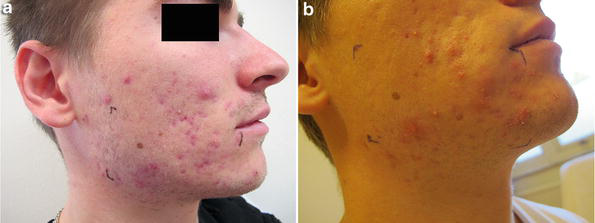
A typical case is presented in Fig. 1a, b, before and after two PDT treatment sessions.
Adverse Effects of PDT
Short-term side effects include erythema and pain. This is often experienced as stinging and burning. The pain sensation is often individual but the larger the area treated, the worse is the pain (Grapengiesser et al. 2002). Men also seem to have more pain. Sometimes blisters occur.
The pain mechanism is not fully understood. Pain control is often achieved by a fan or cold water. Paoli et al. have used nerve blocks with good results (Paoli et al. 2008). MAL-PDT may be less painful than ALA-PDT (Wiegell and Wulf 2006).
Long-term side effects have not been observed so far, but a certain carcinogenic effect cannot be excluded although there is no convincing evidence (Ibbotson 2011).
Other Photosensitizers Than ALA
Other derivatives than ALA are also used. A recent study demonstrated a good effect of chlorophyll-a as the photosensitizer (Song et al. 2014). Also, side effects were minimal. Absorption peaks for chlorophyll are 430 and 662 nm. Hence, in this study blue and red light were used to match the absorption peaks of chlorophyll. Even sebum production decreased. Incubation time is significantly shorter with chlorophyll compared to ALA and MAL.
Indole-3-acetic acid (IAA) using green light has also been used, and the effect is good and the procedure relatively painless. Twenty-five patients were enrolled in the study. IAA was left 15 min under occlusion and green light was given for 15 min. Sebum excretion was also reduced (Jang et al. 2011).
Also, indocyanine green has been used with favorable results (Jang et al. 2011). Thirty-four patients were engaged. Half of the face was treated with indocyanine green with 805 nm radiation and the other half with indole-3-acetic acid and green light (520 nm). Few side effects occurred.
Place in Therapy
Acne may be treated in several ways. For mild to moderate acne, topical preparations may suffice. For more severe acne, antibiotics are often advocated. Unfortunately, bacterial resistance has become a major problem as well as environmental issues.
Hence, there is a need for treatment alternatives to antibiotics. PDT may be such an alternative. Most data are collected concerning ALA-PDT and MAL-PDT but new photosensitizers seem to emerge as an alternative. More studies are needed to elucidate proper dosage regimens and proper light delivery. PDT may well be used more frequently for acne in the future.
Take Home Messages
- P. acnes itself produces small amounts of porphyrins. Irradiation with blue or red light leads to excitation of the endogenously produced porphyrins and formation of singlet oxygen, resulting in bacterial death.
- PDT promotes focused damage of sebaceous glands, decreasing sebum excretion.
- Red light has a better tissue penetration than blue light or UV. Red light has been suggested to have anti-inflammatory properties on acne as well.
- Blue light seems to be the most effective wavelength in photoactivating P. acnes. It seems that blue light alone may be beneficial against acne. Red and blue light might also be combined.
- Photodynamic therapy seems to be effective against moderate acne and may prove to be an alternative to oral antibiotics in the treatment of acne.
References
Asayama-Kosaka S, Akilov OE, Kawana S. Photodynamic therapy with 5% delta-aminolevulinic acid is safe and effective treatment of acne vulgaris in Japanese patients. Laser Therapy. 2014;23(2):115–20.
Cunliffe WJ. Acne and unemployment. Br J Dermatol. 1986;115(3):386.
Das S, Reynolds RV. Recent advances in acne pathogenesis: implications for therapy. Am J Clin Dermatol. 2014;15(6):479–88.
Divaris DX, Kennedy JC, Pottier RH. Phototoxic damage to sebaceous glands and hair follicles of mice after systemic administration of 5-aminolevulinic acid correlates with localized protoporphyrin IX fluorescence. Am J Pathol. 1990;136(4):891–7.
Dong Y et al. A new LED device used for photodynamic therapy in treatment of moderate to severe acne vulgaris. Photodiagnosis Photodyn Ther. 2016;13:188–95. doi: 10.1016/j.pdpdt.2015.06.007. Epub 2015 Jun 23.
Dougherty TJ, et al. Photoradiation therapy for the treatment of malignant tumors. Cancer Res. 1978;38(8):2628–35.
Ericson MB, et al. Fluorescence contrast and threshold limit: implications for photodynamic diagnosis of basal cell carcinoma. J Photochem Photobiol B. 2003;69(2):121–7.
Grapengiesser S, et al. Pain caused by photodynamic therapy of skin cancer. Clin Exp Dermatol. 2002;27(6):493–7.
Guffey JS, Wilborn J. In vitro bactericidal effects of 405-nm and 470-nm blue light. Photomed Laser Surg. 2006;24(6):684–8.
Haedersdal M, Togsverd-Bo K, Wulf HC. Evidence-based review of lasers, light sources and photodynamic therapy in the treatment of acne vulgaris. J Eur Acad Dermatol Venereol. 2008;22(3):267–78.
Hong JS, et al. Acne treatment by methyl aminolevulinate photodynamic therapy with red light vs. intense pulsed light. Int J Dermatol. 2013;52(5):614–9.
Hongcharu W, et al. Topical ALA-photodynamic therapy for the treatment of acne vulgaris. J Invest Dermatol. 2000;115(2):183–92.
Horfelt C, et al. Photodynamic therapy for acne vulgaris: a pilot study of the dose-response and mechanism of action. Acta Derm Venereol. 2007;87(4):325–9.
Horfelt C, et al. Single low-dose red light is as efficacious as methyl-aminolevulinate – photodynamic therapy for treatment of acne: clinical assessment and fluorescence monitoring. Acta Derm Venereol. 2009;89(4):372–8.
Ibbotson SH. Adverse effects of topical photodynamic therapy. Photodermatol Photoimmunol Photomed. 2011;27(3):116–30.
Jang MS, et al. A comparative split-face study of photodynamic therapy with indocyanine green and indole-3-acetic acid for the treatment of acne vulgaris. Br J Dermatol. 2011;165(5):1095–100.
Jeong E, et al. Topical ALA-photodynamic therapy for acne can induce apoptosis of sebocytes and down-regulate their TLR-2 and TLR-4 expression. Ann Dermatol. 2011;23(1):23–32.
Kosaka S, et al. Targeting of sebaceous glands by delta-aminolevulinic acid-based photodynamic therapy: an in vivo study. Lasers Surg Med. 2011;43(5):376–81.
Li X, et al. Effects of 5-aminolevulinic acid-mediated photodynamic therapy on antibiotic-resistant staphylococcal biofilm: an in vitro study. J Surg Res. 2013;184(2):1013–21.
Linkner RV, et al. Evaluating the efficacy of photodynamic therapy with 20% aminolevulinic acid and microdermabrasion as a combination treatment regimen for acne scarring: a split-face, randomized, double-blind pilot study. J Clin Aesth Dermatol. 2014;7(5):32–5.
Liu LH, et al. Randomized trial of three phototherapy methods for the treatment of acne vulgaris in Chinese patients. Photodermatol Photoimmunol Photomed. 2014;30(5):246–53.
Mei X, Shi W, Piao Y. Effectiveness of photodynamic therapy with topical 5-aminolevulinic acid and intense pulsed light in Chinese acne vulgaris patients. Photodermatol Photoimmunol Photomed. 2013;29(2):90–6.
Morton CA, et al. An open study to determine the efficacy of blue light in the treatment of mild to moderate acne. J Dermatolog Treat. 2005;16(4):219–23.
Na JI, Suh DH. Red light phototherapy alone is effective for acne vulgaris: randomized, single-blinded clinical trial. Dermatol Surg. 2007;33(10):1228–33. discussion 1233.
Neittaanmaki-Perttu N, et al. Daylight photodynamic therapy for actinic keratoses: a randomized double-blinded nonsponsored prospective study comparing 5-aminolaevulinic acid nanoemulsion (BF-200) with methyl-5-aminolaevulinate. Br J Dermatol. 2014;171(5):1172–80.
Paoli J, et al. Nerve blocks provide effective pain relief during topical photodynamic therapy for extensive facial actinic keratoses. Clin Exp Dermatol. 2008;33(5):559–64.
Papageorgiou P, Katsambas A, Chu A. Phototherapy with blue (415 nm) and red (660 nm) light in the treatment of acne vulgaris. Br J Dermatol. 2000;142(5):973–8.
Peng Q, et al. Distribution and photosensitizing efficiency of porphyrins induced by application of exogenous 5-aminolevulinic acid in mice bearing mammary carcinoma. Int J Cancer. 1992;52(3):433–43.
Pinto C, et al. Efficacy of red light alone and methyl-aminolaevulinate-photodynamic therapy for the treatment of mild and moderate facial acne. Indian J Dermatol Venereol Leprol. 2013;79(1):77–82.
Pollock B, et al. Topical aminolaevulinic acid-photodynamic therapy for the treatment of acne vulgaris: a study of clinical efficacy and mechanism of action. Br J Dermatol. 2004;151(3):616–22.
Romiti R, et al. High-performance liquid chromatography analysis of porphyrins in Propionibacterium acnes. Arch Dermatol Res. 2000;292(6):320–2.
Sadick N. A study to determine the effect of combination blue (415 nm) and near-infrared (830 nm) light-emitting diode (LED) therapy for moderate acne vulgaris. J Cosmet Laser Ther. 2009;11(2):125–8.
Sandberg C, et al. Bioavailability of aminolaevulinic acid and methylaminolaevulinate in basal cell carcinomas: a perfusion study using microdialysis in vivo. Br J Dermatol. 2008;159(5):1170–6.
Sigurdsson V, Knulst AC, van Weelden H. Phototherapy of acne vulgaris with visible light. Dermatology. 1997;194(3):256–60.
Song BH, et al. Photodynamic therapy using chlorophyll-a in the treatment of acne vulgaris: a randomized, single-blind, split-face study. J Am Acad Dermatol. 2014;71(4):764–71.
Thiboutot D. Dermatologists do not yet fully understand the clinical significance of antibiotic use and bacterial resistance in patients with acne: comment on “Antibiotics, acne, and Staphylococcus aureus colonization. Arch Dermatol. 2011;147(8):921–2.
Wiegell SR, Wulf HC. Photodynamic therapy of acne vulgaris using 5-aminolevulinic acid versus methyl aminolevulinate. J Am Acad Dermatol. 2006;54(4):647–51.
Yin R, et al. Combination ALA-PDT and ablative fractional Er:YAG laser (2,940 nm) on the treatment of severe acne. Lasers Surg Med. 2014;46(3):165–72.
Zheng W, et al. Evidence-based review of photodynamic therapy in the treatment of acne. Eur J Dermatol. 2014;24(4):444–56.