My Personal Experience with Laser
My Personal Experience with Laser
Neal Varughese and David J. Goldberg Skin Laser and Surgery Specialists of New York and New Jersey, New York, NY, USA Department of Dermatology, Icahn Mount Sinai School of Medicine, New York, NY, USA
Abstract
During the last 30 years, I have witnessed firsthand the advances and innovations in laser and energy-based technology. The pioneering work of Anderson and Parrish in 1983 was instrumental in powering this evolution. Anderson and Parrish lead the industry to develop energy-based systems that were more precise, thus allowing clinicians to target specific chromophores with minimal adjacent tissue damage and thereby decreasing the risk of complications. In 1985 upon completion of my dermatologic training, there were limited devices available, and their application was limited to a specific clientele. Fast forward to 2015, the array of devices that are now accessible to the everyday consumer is nothing short of miraculous. The single most effective treatment modality for conditions such as photodamage, acne scars, melasma, and stretch marks is difficult to define. The following chapter outlines my approach to treating these conditions based on my own clinical practice and research.
Keywords Acne scarsMelasmaPhotorejuvenationStretch marksLaser dermatologyCosmetic dermatologyRadiofrequencyIntense pulsed lightLight emitting diode
Photorejuvenation
Photorejuvenation encompasses treatments that address the quality, tone, and texture of the skin and uneven pigmentation associated with photodamage. Initially, the only lasers available were ablative laser devices (CO2 and Er:YAG), which were effective, but had the disadvantage of requiring a high level of operator skill in addition to increased side effects and downtime for patients. In line with new technological developments, there has been a revolution in non-ablative modalities that address photorejuvenation leading to epidermal improvement and dermal collagen remodeling. These modalities include vascular lasers, mid-infrared lasers, intense pulsed light systems, radiofrequency devices, and light-emitting diode (LED) techniques. Epidermal lesions that remain after treatment are amenable to multiple treatment modalities. In such cases, the Q-switched lasers, such as 532 (KTP) and 694 nm (ruby) wavelength, are appropriate.
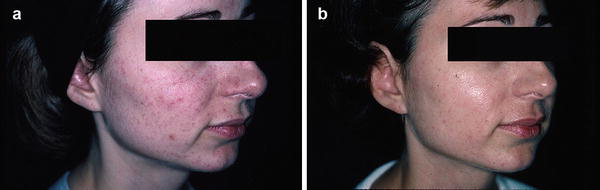
I treat many of my patients with intense pulsed light (IPL) (Fig. 1a, b). IPL encompasses wavelengths from 400 to 1,200 nm which permits the simultaneous treatment of broken capillaries and mottled pigmentation by targeting the chromophores of hemoglobin and melanin (Raulin et al. 2003). Often, the clinical results and patient satisfaction tend to be more impressive when I combine IPL treatments with adjunctive LED treatments. Various LED wavelengths have been shown to improve wound healing and promote human tissue growth. With the application of these techniques, caution needs to be taken in patients with a history of photosensitivity or who take medications that can increase the risk of photosensitivity.
The new IPL devices are very safe; however, scarring and hyperpigmentation still remain a risk. The clinical pearl, especially with darker skin types, is to employ a bleaching cream prior to performing treatment. In treating patients with dark skin types, the use of longer wavelengths or higher cutoff filters as well as longer-pulse durations and lower fluence is recommended. Otherwise, treatment with a mid-infrared laser (1,064–1,450 nm) is an option, as postoperative complications including scarring and postinflammatory hyperpigmentation are minimal when conservative parameters are used (Goldberg 2000).
Additionally, I use more conservative parameters when another device (i.e., KTP, QS ruby) is used in conjunction with IPL.
The ideal patient is 35–55 with mild to moderate photodamage. Although early indications are that results may last for several years, patients who are young may not appreciate the subtle improvement they are receiving from non-ablative resurfacing. Moreover, older patients with severe photodamage and deep wrinkles may require more aggressive surgical and laser cosmetic treatment.
Melasma
Melasma presents a unique challenge to the dermatologic surgeon. Current therapies include topical therapies with bleaching creams, oral medications, chemical peels, and light-based therapies. Although several lasers have demonstrated some potential, they are complicated by transient improvement or rapid recurrence of melasma (Pooja et al. 2012).
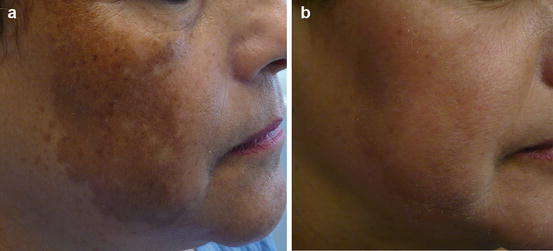
The devices that have shown the most consistent results include IPL, Q-switched and picosecond Nd:YAG lasers, and non-ablative fractional lasers (Fig. 2a, b).
Fractional lasers can be applied to achieve partial pigment improvement but only produce temporary resolution (Goldberg et al. 2008). Low-fluence, long-pulse-duration, high-filter IPL tends to have more lasting results in the treatment of melasma, as the cutoff filter permits the use of longer wavelengths to target deeper melanin. I combine each treatment with LED lights, which have been shown to significantly reduce melanin production and tyrosinase expression. The effects of postinflammatory hyperpigmentation are mitigated with hydroquinone application 4–8 weeks prior to laser treatment and thereafter as a maintenance therapy.
Acne Scars
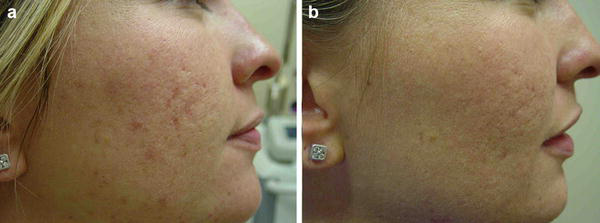
Acne scarring is another difficult dermatological condition to treat. We have found that deep seated scars respond well to ablative lasers. For patients unable to tolerate ablative lasers, non-ablative laser and radiofrequency devices are devices that offer significant improvement in acne scars and skin texture (Fig. 3a, b).
When it comes to treating acne scars in darker skin types, radiofrequency devices play an important role in my practice. Postinflammatory hyperpigmentation (PIH) may be a complication of fractional laser treatments that persists for months, especially in skin types IV–VI (Ong 2012; Hu et al. 2009). To avoid this complication, I utilize a fractional bipolar RF device which generates fractional deep dermal heating to induce skin injury. This subsequently elicits a wound healing response, thereby stimulating the remodeling of dermal collagen. Although the clinical improvements may be more modest as compared to fractional resurfacing, this approach involves extremely rapid recovery and less risk for PIH (Rongsaard and Rummaneethorn 2014).
Stretch Marks
Early in my career, topical retinoids were the gold standard in treating stretch marks. However, lasers have shown much efficacy in treating both early and advanced stretch marks.
In the early stages of stretch marks, changes are more inflammatory in nature, and thus they appear pigmented purple to red. Although there are multiple treatments available for red stretch marks, I prefer the long-pulsed 532 nm KTP and 595 nm pulsed dye lasers in lighter skin types and 1,064 nm Nd:YAG in darker skin types. Conversely, older stretch marks are hypopigmented and atrophic. We have found that the excimer laser is a wonderful option to restore pigmentation (Goldberg et al. 2003). It is important to remember that stretch marks are “dermal scars,” and therefore IPL, fractional photothermolysis, and radiofrequency devices are several options to improve the texture of stretch marks in all skin types.
Conclusion
Laser dermatology continues to evolve at a startling pace. My 30 years of clinical practice have led to me specific treatment regimens for the myriad of conditions previously outlined. Although a variety of treatment options currently exist, the definitive treatment for each condition remains elusive. In my own clinical practice, I have found that the best patient outcomes often occur when energy-based devices are combined with topical or adjunctive therapies.
References
Goldberg DJ. Full-face nonablative dermal remodeling with a 1,320 nm Nd:YAG laser. Dermatol Surg. 2000;26(10):915–8.
Goldberg DJ, Sarradet D, Hussain M. 308-nm excimer laser treatment of mature hypopigmented striae. Dermatol Surg. 2003;29(6):596–9.
Goldberg DJ, Berlin AL, Phelps R. Histologic and ultrastructural analysis of melasma after fractional resurfacing. Lasers Surg Med. 2008;40:134–8.
Hu S, et al. Fractional resurfacing for the treatment of atrophic facial acne scars in Asian skin. Dermatol Surg. 2009;35(5):826–32.
Ong MWS, Bashir SJ. Fractional laser resurfacing for acne scars: a review. Br J Dermatol. 2012;166(6):1160–9.
Pooja A, Rashmi S, Garg VK, Latika A. Lasers for treatment of melasma and post-inflammatory hyperpigmentation. J Cutan Aesthet Surg. 2012;5(2):93–103.
Raulin C, Greve B, Grema H. IPL technology: a review. Lasers Surg Med. 2003;32(2):78–87.
Rongsaard N, Rummaneethorn P. Comparison of a fractional bipolar radiofrequency device and a fractional erbium-doped glass 1,550-nm device for the treatment of atrophic acne scars: a randomized split-face clinical study. Dermatol Surg. 2014;40(1):14–21.