Daylight Photodynamic Therapy and Its Relation to Photodamaged Skin
Daylight Photodynamic Therapy and Its Relation to Photodamaged Skin
Beni Moreinas Grinblat Department of Dermatology, Hospital das Clínicas da Faculdade de Medicina da Universidade de São Paulo, São Paulo, Brazil
Abstract
Photodynamic therapy (PDT) with artificial red or blue light is an option for treating actinic keratosis and field cancerization. In this chapter, we present a new option of photodynamic therapy, with natural daylight as the light source. The method, called daylight-PDT, is a safe, effective, and almost painless treatment for thin actinic keratosis and an option for patients with multiple lesions.
Keywords Daylight photodynamic therapyActinic keratosisPhotodynamic therapyRed lightBlue lightPhotodamagedPhotorejuvenation
Introduction
Daylight photodynamic therapy (DL-PDT) is an option for treatment of thin actinic keratosis. It was developed by Wiegell in 2006 (Wiegell et al. 2008), and since then several studies have been published around the world. The principles of DL-PDT are similar to conventional PDT, with activation of photosensitizers resulting in the formation of reactive oxygen species and cell death. Most of the studies of DL-PDT were performed using aminolevulinate cream (MAL) as the photosensitizer. MAL is a prodrug that is converted to protoporphyrin (PpIX) inside the cell.
Protoporphyrin is activated by visible light, and in DL-PDT the visible light of the natural sunlight spectrum provides the activation.
DL-PDT is indicated for treating thin actinic keratosis (grades I and II, according to Olsen (Olsen et al. 1991)), mainly in patients with multiple lesions on the scalp and/or face.
Besides treating AKs, DL-PDT seems to improve other aspects of photodamage, such as fine wrinkles and pigmentation.
Daylight Photodynamic Therapy
Pre-procedure
There is no specific preparation before treatment with PDT. Patients should keep using daily sunscreens.
Protocol of Procedure
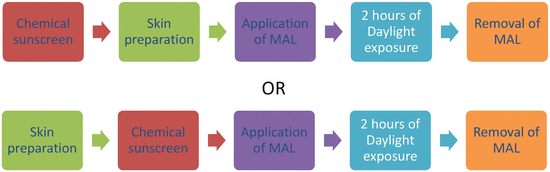
Several studies and international consensus statements (Morton et al. 2015; Gilaberte et al. 2015; Grinblat et al. 2015a) have established the protocol of daylight-PDT (Fig. 1).
- The first step is skin preparation. The objective is to remove scales and crusts and roughen the surface of the skin to enhance MAL penetration. Curettage of the field is the most used method, but there are other options such as slightly abrasive pads and microdermabrasion. Microneedling and ablative lasers might be used but with caution, using smooth parameters.
- An organic sunscreen must be applied over the whole area before or after the skin preparation. The sunscreen (SPF ≥ 30) must be used to block ultraviolet radiation and hence prevent sunburn during the 2 h of daylight exposure.
- In order to block only UV and not the visible light needed to activate PpIX, a chemical sunscreen must be used. Sunscreens containing physical filters such as zinc oxide or titanium dioxide must not be used, because they reflect some visible light and thus may reduce the activation of PpIX by daylight.
- Fifteen minutes after the skin preparation/sunscreen application, the photosensitizer should be applied. Applying a thin layer over the whole area and a thicker one over the AKs is recommended. As mentioned before, the majority of published studies were performed with MAL as the photosensitizer, and occlusion is not recommended. Usually, 1–2 g of MAL cream is sufficient to treat the whole face.
- Up to 30 min after MAL application, the patient has to be exposed to daylight for 120 min. The patient must stay outdoors but can remain in shadow. In Brazil, the procedure can be performed year-round, even in winter (Grinblat et al. 2016). It is recommended to avoid treatment on very cloudy days and, obviously, when it is raining.
- After the illumination (2 h of daylight exposure), the MAL is removed, and the patient has to avoid sun exposure for the rest of the day.
Post-Procedure
The erythema after treatment is usually mild, and topical steroids are not recommended routinely. Patients should keep using daily sunscreens, and the use of moisturizers is indicated.
Side Effects
DL-PDT is usually not painful, and the erythema after treatment is usually mild. Blistering and crusting are very rare.
Discussion
Several studies have been published on DL-PDT in different countries, and they showed similar results when DL-PDT was compared with conventional MAL-PDT for treating thin AKs. The main advantages of DL-PDT are:
- the possibility of treating large areas (face and scalp);
- there is no equipment involved in the treatment;
- DL-PDT is almost painless.
During conventional photodynamic therapy, the pain can be intense. Pain occurs when there is a great amount of PpIX in the cells, and in DL-PDT that does not happen. During treatment with DL-PDT, there is continuous activation of small amounts of porphyrin; there is no accumulation of PpIX in the cells.
In an Australian study (Rubel et al. 2014), DL-PDT was compared with conventional PDT and the clinical results were similar. However, most patients considered DL-PDT much less painful, and most of them preferred DL-PDT.
The Australian study showed similar results when DL-PDT was performed on sunny or cloudy days, and a Brazilian study (Grinblat et al. 2015b) showed good results even when DL-PDT was performed during winter. The Latin-American consensus (Grinblat et al. 2015a) recommends 2 h of daylight exposure at comfortable temperatures.
For most authors, one single treatment of DL-PDT is sufficient, but sometimes another session is indicated, and the authors recommend a 3-month interval before the second treatment. In our experience, patients with intense photodamage need more than one session.
Daylight-PDT is usually indicated for patients with multiple thin AKs (types I and II). By treating the whole area, DL-PDT can be considered a “field cancerization treatment.”
In 2016, Philipp-Dormston and colleagues published a study on DL-PDT for “field cancerization” (Philipp-Dormston et al. 2016). They defined “field cancerization” as an area with photodamage and AK. For those authors, DL-PDT is effective and could prevent the appearance of new AK lesions in photodamaged skin.
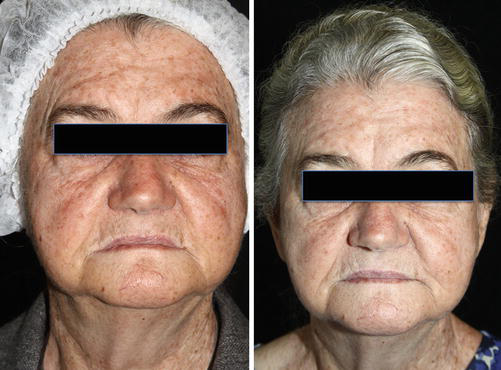
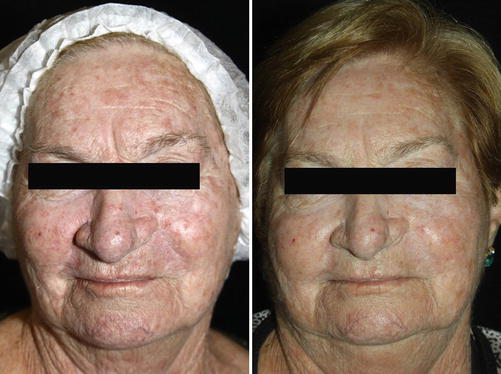
We observe a reduction in the number of AK lesions and improvement of the photodamaged skin (skin texture and pigmentation) in our patients after treatment with only one MAL-DL-PDT with 2 h of daylight exposure (Figs. 2 and 3).
DL-PDT x Photorejuvenation
Besides treating multiple AKs, DL-PDT seems to improve other aspects of photodamage.
Kohl and colleagues published a study on photodynamic rejuvenation. The authors observed improvement of hyperpigmentation, fine wrinkles, and skin tightness after conventional PDT with IPL, blue light, and red light (Kohl et al. 2010). Issa and colleagues showed skin remodeling induced by conventional PDT, with increased expression of metalloproteinase 9 in the dermis and also of collagen type I (Issa et al. 2009). In 2010, the same group showed an increase of collagen and reduction of elastic fibers after conventional MAL-PDT (Issa et al. 2010).
In 2015, a group of experts published that, besides the clearance and prevention of AK, most studies after conventional PDT showed improvement of skin texture (tactile roughness), pale skin, wrinkles, mottled pigmentation, facial erythema, and elastosis (Philipp-Dormston et al. 2016).
There are no data in the literature on photorejuvenation with daylight-PDT, but in our experience patients treated with DL-PDT showed improvement of skin texture. As mentioned, there are several published studies on skin rejuvenation after conventional PDT, and in our experience we can observe improvement of fine wrinkles with DL-PDT, although less than that observed after conventional PDT. According to some authors (Philipp-Dormston et al. 2016), daylight photodynamic therapy could be a complementary and convenient treatment option alongside existing rejuvenation procedures for patients with actinic field damage.
Conclusion
DL-PDT is safe, effective, almost painless, and can be considered a first-line option in the treatment of multiple and thin AKs. Besides the excellent cure rate of AK lesions, an improvement in texture, pigmentation, and fine wrinkles can be observed.
Take Home Messages
- DL-PDT is an option for treatment of thin AK.
- DL-PDT maintains the efficacy of conventional PDT for AK treatment.
- DL-PDT is almost painless. Erythema and edema are very discreet compared with conventional PDT.
- The use of a chemical sunscreen is recommended before application of the photosensitizer.
- DL-PDT seems to improve signs of photodamage.
References
Gilaberte Y, Aguilar M, Almagro M, Correia O, Guillén C, Harto A, Pérez-García B, Pérez-Pérez L, Redondo P, Sánchez-Carpintero I, Serra-Guillén C, Valladares LM. Spanish-Portuguese consensus statement on use of daylight-mediated photodynamic therapy with methyl aminolevulinate in the treatment of actinic keratosis. Actas Dermosifiliogr. 2015;106(8):623–31.
Grinblat B, Galimberti G, Chouela E, Sanclemente G, Lopez M, Alcala D, Torezan L, Pantoja G. Daylight-mediated photodynamic therapy for actinic damage in Latin America: consensus recommendations. Photodermatol Photoimmunol Photomed. 2016;32(2):81–7.
Grinblat BM, Festa Neto C, Sanches Jr JA, Szeimies RM, Oliveira AP, Torezan LA. Daylight photodynamic therapy for actinic keratoses in São Paulo, Brazil. Photodermatol Photoimmunol Photomed. 2015b;31:54–6.
Grinblat BM, Galimberti G, Pantoja G, Sanclemente G, Lopez M, Alcala D, Torezan L, Kerob D, Pascual T, Chouela E. Feasibility of daylight-mediated photodynamic therapy for actinic keratosis throughout the year in Central and South America: a meteorological study. Int J Dermatol. 2016;55(9):e488–93.
Issa MC, Piñeiro-Maceira J, Farias RE, Pureza M, Raggio Luiz R, Manela-Azulay M. Immunohistochemical expression of matrix metalloproteinases in photodamaged skin by photodynamic therapy. Br J Dermatol. 2009;161(3):647–53.
Issa MC, Piñeiro-Maceira J, Vieira MT, Olej B, Mandarim-de-Lacerda CA, Luiz RR, Manela-Azulay M. Photorejuvenation with topical methyl aminolevulinate and red light: a randomized, prospective, clinical, histopathologic, and morphometric study. Dermatol Surg. 2010;36(1):39–48.
Kohl E, Torezan LA, Landthaler M, Szeimies RM. Aesthetic effects of topical photodynamic therapy. J Eur Acad Dermatol Venereol. 2010;24(11):1261–9.
Morton CA, Wulf HC, Szeimies RM, Gilaberte Y, Basset-Seguin N, Sotiriou E, Piaserico S, Hunger RE, Baharlou S, Sidoroff A, Braathen LR. Practical approach to the use of daylight photodynamic therapy with topical methyl aminolevulinate for actinic keratosis: a European consensus. J Eur Acad Dermatol Venereol. 2015;29(9):1718–23.
Olsen EA, Abernethy ML, Kulp-Shorten C, Callen JP, Glazer SD, Huntley A, McCray M, Monroe AB, Tschen E, Wolf Jr JE. A double-blind, vehicle-controlled study evaluating masoprocol cream in the treatment of actinic keratoses on the head and neck. J Am Acad Dermatol. 1991;24:738–43.
Philipp-Dormston WG, Sanclemente G, Torezan L, Tretti Clementoni M, Le Pillouer-Prost A, Cartier H, Szeimies RM, Bjerring P. Daylight photodynamic therapy with MAL cream for large-scale photodamaged skin based on the concept of “actinic field damage”: recommendations of an international expert group. J Eur Acad Dermatol Venereol. 2016;30(1):8–15.
Rubel DM, Spelman L, Murrell DF, See JA, Hewitt D, Foley P, Bosc C, Kerob D, Kerrouche N, Wulf HC, Shumack S. Daylight PDT with MAL cream as a convenient, similarly effective, nearly painless alternative to conventional PDT in actinic keratosis treatment: a randomised controlled trial. Br J Dermatol. 2014;171:1164–71.
Wiegell SR, Haedersdal M, Philipsen PA, Eriksen P, Enk CD, Wulf HC. Continuous activation of PpIX by daylight is as effective as and less painful than conventional photodynamic therapy for actinic keratoses: a randomized, controlled, single-blinded study. Br J Dermatol. 2008;158:740–6.