Laser Safety
Laser Safety
João Paulo Junqueira Magalhães Afonso and Meire Brasil Parada Universidade Federal de São Paulo, São Paulo, Brazil
Abstract
This chapter describes laser safety aspects, from the classification of laser risk through to preventive measures. The main risks, such as eye risks, skin risks, teeth risks, plume risks, fire risks, and electrical risks, are discussed, and preventive measures, from protective equipment through to behavioral aspects, are also addressed.
Keywords LaserSafetyHazardsRiskPreventiveEye riskSkin riskTeeth riskPlume riskFire riskElectrical riskHome-use devices
Introduction
The International Electrotechnical Commission (IEC) is a global organization that prepares and publishes international standards for all electrical, electronic, and related technologies. The IEC document 60825-1 is the primary standard that outlines the safety of laser products (Smalley 2011).
The IEC has published documents that represent international benchmarks of laser safety. These documents are 60601, 60825, and 60825-Part 8. National regulatory agencies usually combine these international recommendations with national legislation to produce local laser safety guidance and/or regulation.
Classification
Classification is based on calculations and determined by the Accessible Emission Limit (AEL), also incorporating viewing conditions, as follows:
Class 1
Class 1 lasers are very low-risk products that are “safe under reasonably foreseeable use,” including the use of optical instruments (eye loupes or binoculars) for direct intrabeam viewing. There is a risk of glare, dazzling, and reduction in color vision due to afterimages:
- Examples: laser printers and compact disc players.
Class 1 M
Class 1 M lasers have wavelengths between 302.5 nm and 400 nm and are safe except when used with optical aids (e.g., microscopes, loupes, binoculars):
- Safe under reasonably foreseeable conditions of operation (unaided eye) but may be hazardous if the user employs optics within the beam.
- Examples: optical fiber communication systems.
Class 2
Class 2 lasers have visible wavelengths (400–700 nm) and are safe if viewed for less than 0.25 s (safe for momentary exposures but hazardous if one deliberately stares into the beam). They do not permit human access to exposure levels beyond the Class 2 AEL for wavelengths between 400 nm and 700 nm. Any emissions outside this wavelength region must be below the Class 1 AEL:
- Emit visible laser beams.
- Not inherently safe for the eyes, but protection by natural aversion responses, such as the blink reflex, is usually adequate.
- Examples: amusement laser guns, laser pointers, and barcode scanners.
Class 2 M
Class 2 M lasers have wavelengths between 400 nm and 700 nm and are potentially hazardous when viewed with an optical instrument. Any emissions outside this wavelength region must be below the Class 1 M AEL:
- Emit visible laser beams.
- Eye protection is normally provided by aversion responses, including the blink reflex, but they may be more hazardous if the user employs optics within the beam.
- Examples: level and orientation instruments for civil engineering applications.
Class 3R
Class 3R lasers are marginally unsafe for intrabeam viewing of beams and are potentially hazardous, but the risk is lower than that of Class 3B lasers, because the accessible emission limit is within five times the Class 2 AEL for wavelengths between 400 nm and 700 nm and within five times the Class 1 AEL for wavelengths outside this region:
- Direct intrabeam viewing is potentially hazardous, but the risk is lower than for Class 3B lasers.
- Fewer manufacturing requirements and control measures for the user than for Class 3B lasers.
- Examples: laser pointers and alignment lasers.
Class 3B
Class 3B lasers are normally hazardous under direct beam viewing conditions but are normally safe when viewing diffuse reflections. They may produce minor skin injuries or even pose a risk of igniting flammable materials:
- Output power of continuous wave not exceeding 0.5 W.
- Examples: lasers for physiotherapy treatments.
Class 4
Class 4 lasers are hazardous under both intrabeam and diffuse reflection viewing conditions. They may also cause skin injuries and are potential fire hazards:
- High-power output devices.
- Output power of continuous wave exceeding 0.5 W.
- Capable of producing hazardous reflections.
- May cause eye and skin injuries.
- Could constitute a fire hazard.
- Require extreme caution in use.
- Examples: laser projection displays, laser surgery devices, and laser metal-cutting devices.
Most of the lasers used in medicine are Class 3 or 4, which means that the risks are greater in every application.
Well-established routines that take these risks into account can prevent mistakes such as those described below.
Preventive Measures
Preventive measures are always the gold-standard choice in laser safety. The control measures are of an engineering, administrative, procedural, and protective-equipment nature.
These measures are listed and described below:
- Engineering measures — manufacturer safety measures built into the systems to prevent accidental emission of laser radiation. Some examples are the guarded foot switch, key lock, housing interlocks, audible and visible emission indicators, beam stops, aperture covers or shutters, standby mode, foot- and hand-operative switches, and contact switches and sensors.
- Administrative measures — continuous monitoring of the safety program by the responsible physician, compliance with laser security measures and a laser safety officer or committee; formal audits; written policies (safety setup checklists, procedure log sheets), procedures, and documentation tools; mandatory education and training programs; and a reporting mechanism for complications.
- Procedural measures — perioperative activities or work practices adopted by all laser personnel in order to prevent complications. This includes controlled access to the laser room; preparing a laser-safe operative site (nonflammable antiseptics and prep solutions, nonreflective material, fire-retardant drapes, avoiding oxygen sources near laser application, bowel preparation in the case of perineal and perianal laser application); controlling electrical hazards; eliminating smoke from the surgical site intraoperatively; setting up, checking, and testing the laser system and accessory equipment before use (test the laser beam firing on a tongue blade before the first use of the day); and assisting the physician and the patient before, during, and after laser application.
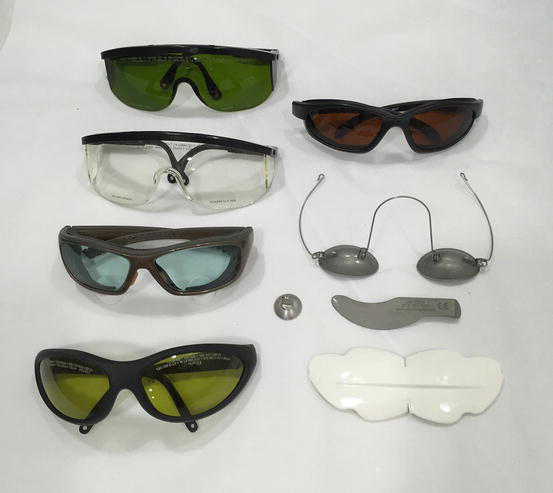
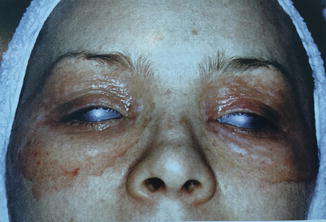
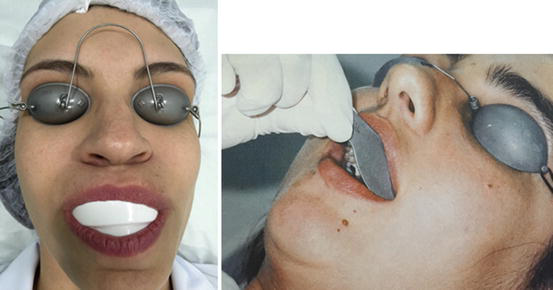
- Protective equipment — window barriers, mirror coverage, signs on the room access door, labels, protective eyewear (Figs. 1, 2, and 3), teeth protection (Fig. 3), fire extinguishers, nonflammable drapes, anodized instruments, skin protection, masks, and smoke evacuation systems with filters (Smalley 2011; Smalley and Goldman 1998).
Hazards Area
It is extremely advisable that visibly posted signs indicate the area where laser hazards exist. In some countries this is a legal obligation. These signs alert staff and patients to the area where laser safety measures are necessary, such as controlled access and wearing safety glasses. It is also advisable that at each entryway to this area, protective goggles are always available during laser operation in case of emergency entry into the area.
The doors must always be closed but never locked during laser use.
Beam Hazards: Related to Direct or Reflected Impact of the Laser Beam to Tissue
Eye Risks
The human eye has as its only defense system the “blink reflex.” This reflex takes one-fourth of a second to be effective. As lasers work on milli-, nano-, and picosecond scales, it is not possible for the blink reflex to protect against them. Furthermore, some lasers do not work at wavelengths of bright visible light, such as infrared ones, which do not elicit the reflex.
Even with the eyelids closed, some lasers can cause damage to the eyes, which makes us emphasize even more the importance of eye protection.
The eye lens is capable of focusing light onto a very small point on the retina, which makes the coherent light of lasers even more dangerous (Dudelzak and Goldberg 2011). As is known, even a laser pointer with an output greater than 5 mW can induce permanent eye injury. Thus, many professional laser devices and home-use devices are able to cause eye damage.
Some laser variables are related to the intensity of eye injury. The laser variables are:
- Wavelength. Lasers operating at wavelengths of ultraviolet (200–400 nm), mid-infrared (1400–3000 nm), and far-infrared (3000–10,600 nm) are absorbed by the anterior ocular segment, inflicting damage on the lens and cornea.
Visible light lasers (400–760 nm) and near-infrared ones (760–1400 nm) are absorbed in the posterior ocular segment by the retina and vascular choroid.
Wavelengths above 700 nm and below 400 nm may cause photochemical damage to the cornea and lens cataract, and wavelengths above 1400 nm can cause corneal burns.
Blind spots and glaucoma due to damage to retinal vessels and pigmented iris are also possible.
The chromophores of the eye are the same as those in daily use in dermatology, such as water, melanin, and hemoglobin.
Lasers such as CO2 (10,600 nm), Nd:YAG (1320 and 1064 nm), alexandrite (755 nm), Diodo (810 nm), Er:YAG (2940 nm), and Q-switched ones (alexandrite, ruby, and Nd:YAG) can cause damage to multiple structures of the eye through mechanisms of photochemical, photothermal, and photoacoustic damage.
- Pulse duration. The pulse duration of almost all lasers used in dermatology is shorter than the blink reflex elicitation time (0.25 s), which makes almost all pulse durations a risk. The shorter the pulse duration, the faster the delivery of the energy defined in the parameters.
- Energy/fluence. The higher the energy defined in the parameters, the greater the risk of eye damage.
- Beam diameter. The beam diameter can influence the outcome to a greater or lesser degree according to the wavelength and the position of incidence on the eye.
The damage is also modified by eye variables. The eye variables are:
- The location of damage in the eye (foveal injuries are worst).
- The iris color (dark-skinned ones are worst).
- If the pupil is dilated (night lesions or lesions in the dark can be more dangerous than in daylight).
- The state of refraction of the eye at the moment of injury (if the focus lies before or behind the retina, the damage can be less or more intense) (Barkana and Belkin 2000).
After the eye is damaged by a laser, the primary injury can evolve into secondary eye injuries caused by shock waves, heat, and the release of various noxious agents by the directly injured neurons (Lee et al. 2011).
If damage occurs, the treatment options are few. Corticosteroids are the main choice, but anecdotal case reports have used antioxidant vitamins and vasodilator drugs. There are drugs under development intended to block secondary injury; these are called neuroprotective compounds. Some reports also suggest the use of growth factors (Lin et al. 2011; Jewsbury and Morgan 2012).
Sometimes surgery may be necessary for treatment.
Because of the above, eye protection is one of the most important topics in laser training, laser use, and laser safety.
Eye protection must be considered for the patient, for the physician, and for support personnel. Goggles are the main component of eye protection, and goggles for protection against laser wavelengths are specially designed for that purpose.
Patient goggles may be made of heatproof stainless steel with a smooth polished concave surface and an anodized convex surface without any transparency (for external or topical use). Staff goggles are generally made of another material, such as coated glass or polymeric material with selected transparency. The selected transparency is chosen according to the laser that will be used, because the lenses can block a central wavelength or a band of wavelengths. Another characteristic of these goggles is the optical density (OD), which is the log of attenuation of the light transmitted through the lens. Thus, a lens with an OD of 4 allows 1/104 of the laser energy to penetrate. These goggles may also have side shields and no front surface reflection.
All goggles should have permanent labels indicating wavelengths and optical density, side shields, adequate visible-light transmission, and a proper, comfortable fit.
When goggles are cracked, scratched, discolored, or show any other damage to the lens, frame, or straps, they should be replaced.
Abrasive cleaning methods and alcohol-based cleaning solutions can degrade the optical coating on the lenses and decrease the optical density, resulting in eye injury.
As eye injury may be caused by reflected laser light and not only by direct emission, all jewelry should be removed, window glass and mirrors should be covered, and all instruments should be anodized, roughened, or ebonized with a fluoropolymeric coating. Reflection is not related to instrument color, as black can be as reflective as silver.
Chlorhexidine should not be used to disinfect eye-contact goggles because this substance may cause keratitis and corneal opacification.
According to national regulations, door warning signs may be placed outside laser operating rooms to alert visitors to the risks.
Some technologies to transform lasers into eye-safe machines have been suggested, such as efficient wide-angle forward-scattering diffusers that would change the coherent nature of lasers and intense pulsed lights (IPLs) into noncoherent light. This is theoretically justified because the biological effect of lasers and IPLs occurs after the light from these sources is scattered in the skin before acting on its final target (the chromophores). The coherent nature of these light sources is therefore not essential for treatment efficiency. However, this technology is not applicable to all types of lasers and still must be further developed (Slatkine and Elman 2003).
It is important to remember that goggle protection is also necessary to protect the eyes from splatter of biological material that can occur after laser impact on tissue.
Skin Risks
Skin risks are related to inappropriate selection of patients, energy, pulse duration, or any other controllable laser parameter, or to inadvertent firing of the laser.
To avoid skin risks, continuous education and training programs are essential, since incorrect use of a single laser variable may cause great damage to the skin.
Understanding the physics, laser–tissue interaction, laser parameters and variables, knowing the characteristics of the specific machine that will be used in that treatment and of the patient's skin, and tailoring these variables to each case are the best ways to prevent accidental damage to the skin.
Cooling is also a good way to prevent laser damage in some cases.
Depigmenting the skin prior to laser therapy with topical hydroquinone, starting 4 weeks before, is a method that can diminish some risks.
Skin damage can result in temporary or permanent lesions, such as erythema, edema, crusting, blistering, scarring, atrophy, or hyper- or hypopigmentation (Dudelzak and Goldberg 2011).
Table 1 shows which damage each kind of radiation can cause in the skin and eyes.
| Wavelength range | Spectrum | Eyes | Skin |
|---|---|---|---|
| 200–280 nm | UVC | Photokeratitis (inflammation of the cornea, equivalent to sunburn) | Erythema, burns, and skin cancer |
| 280–315 nm | UVB | Photokeratitis (inflammation of the cornea, equivalent to sunburn) | Tanning, burns, and skin cancer |
| 315–400 nm | UVA | Photochemical cataract (clouding of the eye lens) | Photoaging, tanning, and skin cancer |
| 400–780 nm | Visible | Photochemical damage to the retina, retinal burn | Burns, photosensitivity reactions, and increasing pigmentation |
| 780–1400 nm | Infrared A | Cataract, retinal burn | Burns |
| 1400–3000 nm | Infrared B | Aqueous flare (protein in the aqueous humor), cataract, corneal burn | Burns |
| 3000–10,000 nm | Infrared C | Corneal burn | Burns |
Teeth Risks
Dental enamel is vulnerable to ultraviolet and infrared light. When using a laser near the mouth, the patient should be alerted to keep the mouth closed, and some protection may be used, such as moistened gauze and a protective mouthpiece (Fader and Ratner 2000).
Possible teeth damage includes charring, cracking, flaking, and craters.
Non-beam Hazards: Secondary Hazards Not Related to the Beam Directly
Fire Hazard
The combustible materials below are at risk of ignition when exposed to certain lasers:
- Gauze
- Towels
- Drapes
- Dry sponges
- Plastics
- Rubber
- Tape removers
- Skin degreasers and skin preparation solutions
- Foam devices
- Respiratory devices (face masks, nasal cannulae)
- Methane gas (perianal area)
- Makeup, hair spray, alcohol-based mousse or gels, nail polish
- Oil-based eye ointments
- Products containing alcohol
- Solutions with iodophors
- Hair-bearing areas
Some of these at-risk materials can be prepared with saline solution prior to the procedure to reduce the risk of ignition. Other materials may be kept out of the laser room.
When using the CO2 laser on tissue, it is important to note that a carbonized tissue layer generally builds up during application. This layer blocks laser penetration and continuously heats. If not removed, this carbon layer can heat to temperatures over 1000 °C, making fire ignition, burns, and extensive tissue damage possible (Fader and Ratner 2000).
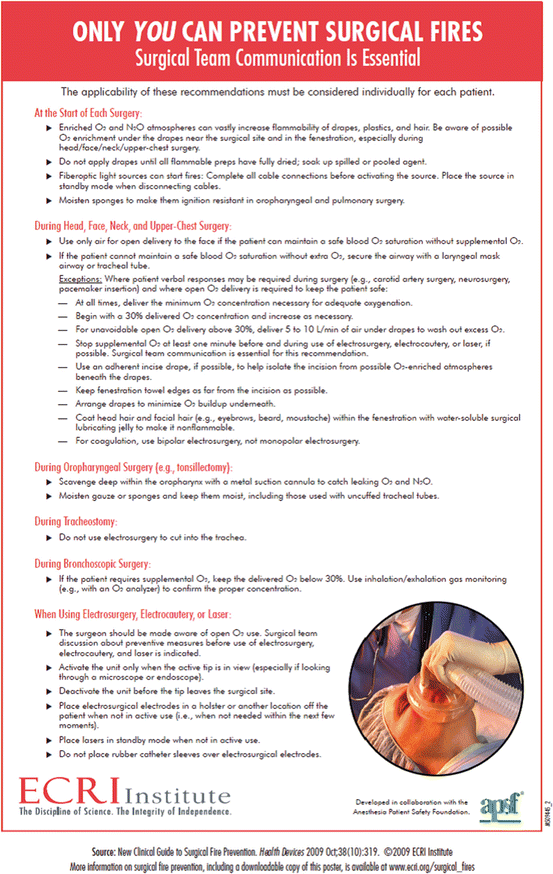
Hair and cotton can be ignited by lasers in an enriched-oxygen atmosphere or when not soaked with saline solution.
A fire extinguisher for standard electrical equipment and a container of water must be available for any emergency when working with fire hazards.
The O2-enriched atmosphere is the most common cause of fire in laser use (Sheinbein and Loeb 2010). Fire ignition can occur even outside the laser treatment field (remote fire), as reported in the literature (Waldorf et al. 1996) (Fig. 4).
Electrical Hazard
Laser devices are high-voltage, high-current instruments, and there is great risk of circuitry fire and electrocution. Only trained personnel may operate these devices.
Correct installation and grounding are very important in preventing electrical hazards.
The integrity of the clamps, connecting cords, power cords, fuses, circuit breakers, and plugs may be checked before use (Dudelzak and Goldberg 2011).
Plume Hazard
Plume and smoke are frequently produced during laser use, and the mutagenic and carcinogenic capacity of these byproducts is already recognized.
Disease transmission through plume and smoke has also been described and should be of concern to healthcare professionals and support staff (Sawchuk et al. 1989).
Red blood cells, cellular clumps, bacteria, HIV, and HPV DNA have been recovered from laser plume. Carbon particles, benzene, formaldehyde, acrolein, and over 41 toxic gases have been proven to be liberated by tissue after laser thermal disruption of cells (Andre et al. 1990; Ulmer 2008).
A laser surgeon with infection of the anterior nasal nares and another with laryngeal papillomatosis after treating anogenital papillomatosis have been reported in the literature (Hallmo and Naess 1991).
The carbon and toxic compounds, such as formaldehyde and benzene, that exist in the plume can cause (Ulmer 2008):
- Asthma
- Anemia
- Anxiety
- Bronchiolitis
- Carcinoma
- Cardiovascular dysfunction
- Colic
- Congestive interstitial pneumonia
- Dermatitis
- Dizziness
- Emphysema
- Eye irritation
- Headache
- Hepatitis
- HIV
- Hypoxia
- Lacrimation
- Leukemia
- Light-headedness
- Nasopharyngeal lesions
- Nausea or vomiting
- Sneezing
- Throat irritation
- Weakness
Common surgical masks are not able to filter the very small particles produced during laser application. Laser masks are made of electrostatically charged synthetic fibers and should be replaced periodically because the smoke eliminates their polarity after a period of use. However, masks are not considered first-line protective devices, as their chance of failing after 20 min of use is high. Fit and wearing technique also interfere with mask efficiency.
Smoke aspiration and elimination are extremely necessary at the site and in the room of laser application and constitute the first-line protective device (Bigony 2007). The device should employ a triple-filter system. The high-efficiency particulate air filter, which removes particles larger than 0.3 μm, is not sufficient; an ultralow particulate air filter, capable of removing particulate matter down to 0.1 μm in size, is necessary, together with a charcoal filter to remove toxic chemicals from the smoke.
Some aspects to be evaluated before choosing a smoke aspirator are:
- Cost and operating expenses
- Effectiveness
- Filter and canister design
- Filter monitoring
- Fluid removal capabilities
- Foot-pedal activation versus automatic activation
- Noise production
- Single use versus reusable
- Size
The recommended distance between the laser-treated site and the suction tip is 1 cm, and effectiveness drops from 99% to 50% when this distance changes from 1 to 2 cm.
After laser use, the room atmosphere may take 20 min to return to a normal concentration of particles.
Q-switched lasers present a particular challenge because they generate high-speed tissue fragments and particles that may escape capture by the smoke evacuation device. Some specific safety measures have been recommended in these situations, such as splatter shields or collecting cones, treatment through a transparent membrane, appropriate eye protection, gloves, gowns, and laser surgical masks.
Some laser surgeons cover lesions with optically clear biological dressings and shoot through them, sacrificing a 5–10% energy drop for a clean and elegant protective barrier.
The recent application of lasers in the treatment of fungal infections like onychomycosis has raised the alert to the possibility of viable fungi in the smoke (Karsai and Däschlein 2012).
More intriguing is the suggestion by some authors that plume can spread viable malignant cells, such as melanoma cells, to other sites (Lewin et al. 2011).
The American Academy of Dermatology recommends the use of face masks, eye protectors, gloves, gowns, caps, and shoe covers (Dover et al. 1999).
After surgery, one should remember that the smoke may have contaminated both covered and uncovered body surfaces. Washing the hands and other body parts is therefore advisable.
“Of all safety hazards, complacency is by far the most dangerous. Accidents happen when we adopt the attitude: ‘I have been using lasers for years; we’ve never had a problem and it won’t happen here.’” — Smalley and Goldman (1998)
This attitude causes the surgeon and staff to relax on preventive measures, opening the way for mistakes and accidents.
Home-Use Intense Pulsed Light (IPL) and Laser Devices Safety
Home-use epilation devices use the same principle of selective photothermolysis as professional devices. Some differences, however, are important in home-use devices compared with professional ones:
- Low energy
- Few energy settings
- Fixed pulse duration
- Single fixed filter
- Small treatment areas
- Parallel skin cooling not possible
- Cover fewer skin tones
These differences should alert manufacturers and healthcare providers not to carry over the clinical experience and knowledge from published studies about professional devices to the home-use ones (Town et al. 2012).
It is, however, reasonable to expect similar side effects but with different incidences between these two kinds of devices.
The most common adverse effects reported in some studied devices were erythema, edema, pain, pigmentary changes, skin abrasion, folliculitis, skin irritation, pruritus, stinging, tingling, dry skin, and blistering.
Although these adverse effects were not too frequent, the studies selected subjects with inclusion and exclusion criteria in order to diminish risks. From the moment the devices become available to the general population with no control of “inclusion and exclusion criteria,” the incidence of adverse effects is expected to be higher in real-life daily use.
Home-Use Devices: Desirable Characteristics
- Eye safe
- Easy to use without training
- Clinically effective (causing follicular biological damage without causing epidermal or ocular damage)
- Cost-effective in mass production
Manufacturers have developed different technologies to achieve these characteristics, such as contact switches or sensors, auto-standby, and low-energy presets, and in some countries they then seek reclassification of these devices into the Class 1 laser category, which would not require the use of safety glasses. The reclassification is under evaluation and is not yet approved (Thaysen-Petersen et al. 2012).
Many of the devices do not report the claimed fluence, pulse duration, wavelength, and homogeneity or spectral output (in the case of IPLs), which complicates safety evaluation.
Some studied home-use devices showed risks of skin and eye damage regardless of the safety mechanisms adopted by manufacturers. Moreover, patients can misclassify their skin tone and can apply the devices to tanned skin, and safety mechanisms can fail. All these variables should be considered when classifying the safety of home-use devices (Town and Ash 2010).
Regulatory standards are not well defined in many countries, and some important measures regarding user education should be adopted:
- Comprehensive education materials (e.g., user manuals)
- Consumer care support (e.g., telephone helpline support)
- Detailed instructions for use
- DVDs
- In-store trained sales consultants
- Physician-directed use of home-use devices
- Web-based tutorials
Because home-use devices will be used as household appliances, safety measures include those for electrical safety, assembly, maintenance, disposal, labeling, and categorization of consumer risk (as for children).
Other issues may be considered when home-use devices are used by nonprofessional users:
- Treating areas with melanocytic nevi.
- Treating areas with tattoos.
- Treating individuals with polycystic ovarian syndrome or ovarian hyperandrogenism.
- Treating pregnant women.
- Treating tanned skin.
- Treating still-healing skin.
- Treating individuals using photosensitizers or phototoxic drugs (especially with IPL devices).
- Treating the face and eyebrows.
- Treating with suboptimal energy may induce paradoxical hair growth on home-use devices, which typically work with lower energies than professional ones.
Take Home Messages
- Lasers used in medicine can generally be high-risk devices.
- Preventive measures will be effective if all staff involved follow safety routines that take the risks into account.
- The most dangerous intrabeam risk is the eye risk, which may lead to complete blindness.
- The non-beam hazards are diverse, and the most frequently reported is related to plume.
- Home-use devices are not free of risks, and consumers should be made aware of the risks.
Cross-References
- CO2 Laser for Other Indications
- CO2 Laser for Scars
- CO2 Laser for Stretch Marks
- CO2 Laser for Photorejuvenation
- Erbium Laser for Photorejuvenation
- Erbium Laser for Scars and Striae Distensae
- Fractional Ablative and Non-Ablative Lasers for Ethnic Skin
- Intense Pulsed Light for Photorejuvenation
- Intense Pulsed Light for Rosacea and Other Indications
- Lasers for Aesthetic and Functional Vaginal Rejuvenation
- Laser on Hair Regrowth
- Laser for Hair Removal
- Laser Lipolysis
- Laser for Onychomycosis
- Laser Treatment of Vascular Lesions
- Light-Emitting Diode for Acne, Scars, and Photodamaged Skin
- My Personal Experience with Laser
- Non-ablative Fractional Lasers for Scars
- Non-ablative Lasers for Photorejuvenation
- Non-ablative Lasers for Stretch Marks
- Photodynamic Therapy for Acne
- Photodynamic Therapy for Photodamaged Skin
- Q-Switched Lasers for Melasma, Dark Circles of the Eyes, and Photorejuvenation
- Transepidermal Drug Delivery with Ablative Methods (Lasers and Radiofrequency)
References
Andre P, Orth G, Evenou P, Guillaume JC, Avril MF. Risk of papillomavirus infection in carbon dioxide laser treatment of genital lesions. J Am Acad Dermatol. 1990;22(1):131–2.
Barkana Y, Belkin M. Laser eye injuries. Surv Ophthalmol. 2000;44(6):459–78.
Bigony L. Risks associated with exposure to surgical smoke plume: a review of the literature. AORN J. 2007;86(6):1013–20; quiz 1021–4.
Dover JS, Arndt KA, Dinehart SM, Fitzpatrick RE, Gonzalez E. Guidelines of care for laser surgery. American Academy of Dermatology, Guidelines/Outcomes Committee. J Am Acad Dermatol. 1999 Sep;41(3 Pt 1):484–95.
Dudelzak J, Goldberg DJ. Laser safety. Curr Probl Dermatol. 2011;42:35–9.
Fader DJ, Ratner D. Principles of CO2/erbium laser safety. Dermatol Surg. 2000;26(3):235–9.
Hallmo P, Naess O. Laryngeal papillomatosis with human papillomavirus DNA contracted by a laser surgeon. Eur Arch Otorhinolaryngol. 1991;248(7):425–7.
Jewsbury H, Morgan F. Uveitis and iris photoablation secondary to intense pulsed light therapy. Can J Ophthalmol. 2012;47(4):e13–4.
Karsai S, Däschlein G. “Smoking guns”: hazards generated by laser and electrocautery smoke. J Dtsch Dermatol Ges. 2012;10(9):633–6.
Lee WW, Murdock J, Albini TA, O’Brien TP, Levine ML. Ocular damage secondary to intense pulse light therapy to the face. Ophthal Plast Reconstr Surg. 2011;27(4):263–5.
Lewin JM, Brauer JA, Ostad A. Surgical smoke and the dermatologist. J Am Acad Dermatol. 2011;65(3):636–41.
Lin CC, Tseng PC, Chen CC, Woung LC, Liou SW. Iritis and pupillary distortion after periorbital cosmetic alexandrite laser. Graefes Arch Clin Exp Ophthalmol. 2011;249(5):783–5.
Mattos R. Conceitos de Biossegurança: Laser/Dermatologia. In: Kadunc B, Palermo E, Addor F, Metsavaht L, Rabello L, Mattos R, Martins S, editors. Tratado de cirurgia dermatológica, cosmiatria e laser: da Sociedade Brasileira de Dermatologia. 1st ed. Rio de Janeiro: Elsevier; 2012. p. 895–9.
Sawchuk WS, Weber PJ, Lowy DR, Dzubow LM. Infectious papillomavirus in the vapor of warts treated with carbon dioxide laser or electrocoagulation: detection and protection. J Am Acad Dermatol. 1989;21(1):41–9.
Sheinbein DS, Loeb RG. Laser surgery and fire hazards in ear, nose, and throat surgeries. Anesthesiol Clin. 2010;28(3):485–96.
Slatkine M, Elman M. Conversion of aesthetic lasers and intense pulsed light sources into inherently eye-safe units. J Cosmet Laser Ther. 2003;5(3–4):175–81.
Smalley PJ. Laser safety: risks, hazards, and control measures. Laser Ther. 2011;20(2):95–106.
Smalley PJ, Goldman MP. Laser safety: regulations, standards and practice guidelines. In: Goldman MP, Fitzpatrick RE, editors. Cutaneous laser surgery: the art and science of selective photothermolysis. 2nd ed. St. Louis: Mosby Inc; 1998. p. 459–72.
Thaysen-Petersen D, Bjerring P, Dierickx C, Nash JF, Town G, Haedersdal M. A systematic review of light-based home-use devices for hair removal and considerations on human safety. J Eur Acad Dermatol Venereol. 2012;26(5):545–53.
Town G, Ash C. Are home-use intense pulsed light (IPL) devices safe? Lasers Med Sci. 2010;25(6):773–80.
Town G, Ash C, Dierickx C, Fritz K, Bjerring P, Haedersdal M. Guidelines on the safety of light-based home-use hair removal devices from the European Society for Laser Dermatology. J Eur Acad Dermatol Venereol. 2012;26(7):799–811.
Ulmer BC. The hazards of surgical smoke. AORN J. 2008;87(4):721–34; quiz 735–8.
Waldorf HA, Kauvar NB, Geronemus RG, Leffel DJ. Remote fire with the pulsed dye laser: risk and prevention. J Am Acad Dermatol. 1996;34(3):503–6.