Laser Lipolysis
Laser Lipolysis
Paula Amendola Bellotti Schwartz de Azevedo Brazilian Society of Dermatology and Brazilian Society of Dermatology Surgery, Rio de Janeiro, Brazil Bianca Bretas de Macedo Silva Brazilian Society of Dermatology, Rio de Janeiro, Brazil Leticia Almeida Silva Brazilian Society of Laser in Medicine and Surgery, Avenida Afranio de Melo Franco, 141/3 Andar – Leblon, Rio de Janeiro, RJ, Brazil
Abstract
Studies concerning laser’s direct action on fat began in 1992. Two years later the first study of laser lipolysis was produced. The method was approved by the FDA in October 2006. Laser lipolysis is a minimally invasive procedure for the treatment of localized fat, improving facial and body contour and flaccidity. It consists of the application of laser directly on the adipose tissue, based on the principle of selective photothermolysis. This method has the advantage of being less traumatic; of causing less bleeding, pain, ecchymosis, and edema; and it minimizes side effects and complications. The postoperative recovery time is reduced when compared to conventional liposuction. There is induction of neocollagenesis, which leads to cutaneous retraction. Indications include the submental area, arms, abdomen, flanks, inner surface of thighs, knees, and elbows. Patients with irregularities after previous liposuction or other surgeries are also excellent candidates. For areas with more fibrous tissue, such as the male breast (gynecomastia), flanks, and back, laser lipolysis may be the only option. Recent articles described the use of laser lipolysis for the treatment of lipoma, as conventional surgery can result in disfiguring scars when treating lesions bigger than 10 cm. Other questionable indications are axillary hyperhidrosis and cellulite. There are no specific contraindications. Complications are rare, and when they occur they are not specific to the laser.
Keywords Laser lipolysisFatLocalized fatBody contourFlaccidityCutaneous retractionCelluliteLiposuctionNeocollagenesisSubmentalGynecomastia
Introduction
In 1992, Apfelberg was the first to describe laser’s direct action on fat. Two years later, he and collaborators produced the first study of laser lipolysis. However, its benefit was not significantly demonstrated. This equipment was not approved by the FDA, and the company Heraeus Lasersonics abandoned the technology (Apfelberg et al. 1994).
The first study to demonstrate the effect of laser on fat, as well as on the dermis, vessels, and apocrine and eccrine glands, was described between 2002 and 2003 by Bluggerman, Schavelzon, and Goldman, who introduced the concept of pulsed laser for laser lipolysis (Apfelberg et al. 1994).
In 2003, Badin founded these findings in one study titled “Laser Lipolysis: Flaccidity Under Control.” The author demonstrated the histological changes after the thermal laser injury. The adipocytes’ membrane was torn, vessels were coagulated, and collagen was reorganized. These histological changes were correlated with the clinical observation of reducing adiposity, ecchymosis, blood loss, and improvement of flaccidity. Badin concluded that laser lipolysis was less traumatic because of the cannula’s smaller pitch and that this type of laser, Nd:YAG, produced a tissue reaction leading to cutaneous retraction (Badin et al. 2002).
In a subsequent study carried out by Goldman, 1734 patients were treated, including 313 men and 1421 women aged 15–78. In this group, less blood loss and ecchymosis, improvement of postoperative comfort, and better effectiveness of fat reduction in denser areas such as gynecomastia, for example, were also documented (Kim and Geronemus 2006).
In 2006, a study by Kim and Geronemus used magnetic resonance to evaluate the volume of fat reduction after laser lipolysis. Seventeen percent of patients achieved a reduction of fat volume documented by magnetic resonance imaging, and 37% noticed an improvement in only 3 months, a quick recovery time and good cutaneous retraction (Kim and Geronemus 2006).
In this same year, the FDA approved the first laser lipolysis equipment, an Nd:YAG laser of 6 W (produced by DEKA and distributed by Cynosure, Westfort, Massachusetts). Soon after, several devices with different wavelengths entered the market (Table 1).
| Commercial name | Wavelength (nm) | Laser type |
|---|---|---|
| SmartLipo (Cynosure, Westfort, MA), FDA approval 2006 | 1064/1320 | Nd:YAG |
| ProLipo (Sciton, Palo Alto, CA), FDA approval 2007 | 1064/1319 | Nd:YAG |
| CoolLipo (CoolTouch, Roseville, CA), FDA approval 2008 | 1320 | Nd:YAG |
| LipoLite (Syneron, Yokneam, Israel), FDA approval 2008 | 1064 | Nd:YAG |
| SlimLipo (Palomar, Burlington, MA), FDA approval 2008 | 924/975 | Diode |
In 2007, Morton et al. detailed a mathematical model that compared equipment with a 980 nm laser diode to a 1064 nm Nd:YAG. This study suggested that regardless of the wavelength, what really drove the lipolysis and skin contraction was the heating. They mentioned that the internal temperature required to achieve contraction ranged from 48 °C to 50 °C (118–122 °F) (Morton 2008).
In 2008, McBean and Katz studied equipment which associated two wavelengths, 1064 and 1320 nm, respectively the SmartLipo®. The objectives of the study were to assess cutaneous safety and effectiveness. The effect of cutaneous retraction was documented by photographic documentation and measurement, as well as through histological studies and electron microscopy, which revealed neocollagenesis. This was the first study to demonstrate the clinical effects of cutaneous retraction produced by laser lipolysis, with objective measures proven by electron microscopy (McBean and Katz 2009).
In the same year, Palomar launched the Aspire™ platform (SlimLipo®) on the market, a laser diode with two selective and safe wavelengths: the 924 nm for fatty cells and the 975 nm, with greater selectivity for water in the connective tissue, promoting cutaneous retraction (McBean and Katz 2009).
Today, it has become clear that laser lipolysis liquefies fat and promotes remodeling of collagen fibers, improving flaccidity. Currently, new research aims to standardize the methods that will optimize results, safety, and efficacy.
Laser lipolysis is a new technique, a minimally invasive procedure for the treatment of localized fat and laxity, improving facial and body contour. It consists of the application of laser directly on the adipose tissue, based on the principle of selective photothermolysis. This method has the advantage of being less traumatic and of causing less bleeding, reducing the postoperative recovery time when compared to conventional liposuction.
Since its approval by the FDA in October 2006, studies have corroborated the early clinical observation of adipose tissue reduction, rapid recovery, and flaccidity improvement.
Goldman proposed that two properties must be considered to determine the effectiveness of laser lipolysis: wavelength and the energy employed. According to the theory of selective photothermolysis, these chromophores (fat, collagen, and blood vessels) preferentially absorb the laser energy based on the specific absorption coefficient, according to the wavelength. Many wavelengths, including 924, 968, 980, 1064, 1319, 1320, 1344, and 1440 nm, have been evaluated for their interaction with these chromophores. Many authors suggest that certain wavelengths are more effective for lipolysis (DiBernardo et al. 2009).
Parlette and Kaminer documented that the 924 nm wavelength has higher selectivity to absorb fat, but it is not effective in inducing cutaneous retraction and improving laxity. They showed that the 1064 nm wavelength has good penetration in the tissue but low absorption by fat. However, its distribution of heating is superior, with a good cutaneous retraction effect. Finally, the 1320 wavelength has demonstrated great absorption by fat but low penetration in the tissue, so it is safe for treating more fragile skin, such as in the neck and arm areas (Parlette and Kaminer 2008).
The different wavelengths have variable absorption coefficients for fat, water, and hemoglobin. Fat contains approximately 14% water, and collagen 60–70%; therefore the appropriate selection of the laser allows a preferential target of fat and/or water. When comparing light absorption by fat and by the dermis, the highest selectivity to melt fat happens when a 924 nm laser diode is used. Due to the great absorption of light directly into fat, the heating effect is limited to the fibrous septum of fat and to the reticular dermis, preserving the underlying tissues, with less risk of thermal damage. Less trauma from suction will be necessary due to the great fat liquefaction (Parlette and Kaminer 2008).
There are multiple laser systems for lipolysis. Current technologies use small optical fibers 1–2 mm thick to transmit the laser directly into the subcutaneous tissue; the 924 nm has the highest affinity for fat and less heating of the collagen. Therefore, it promotes greater liquefaction of fat and less tissue retraction (McBean and Katz 2011).
Rupture and liquefaction of the adipose tissue, coagulation of small blood and lymphatic vessels, and collagenesis induction with tissue remodeling have been reported after laser lipolysis treatment. Other mechanisms of action such as photoacoustic and photomechanical effects have been purported (DiBernardo and Reyes 2009).
Indications and Contraindications
The primary indication of laser lipolysis is the treatment of localized fat through the liquefaction of the adipose tissue. Any location where there is localized fat and moderate flaccidity, including the submental, arms, abdomen, flanks, the inner surface of thighs, knees, and elbows, has an indication for this procedure because it simultaneously promotes cutaneous retraction through neocollagenesis. It is very well indicated for facial contour (Fig. 1a, b) (McBean and Katz 2011).
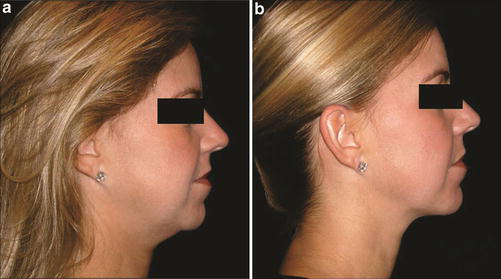
Patients with irregularities after liposuction and other surgeries are also excellent candidates. For areas with more fibrous tissue such as the male breast (gynecomastia), flanks, and back, laser lipolysis may be the only option. The small size of the cannula facilitates treatment in these fibrous areas without the additional trauma (McBean and Katz 2011; Palm and Goldman 2009).
Recent articles described the use of laser lipolysis for the treatment of lipoma, considering that conventional surgery for lesions bigger than 10 cm can result in disfiguring scars. Laser lipolysis alone or associated with aspiration by suction facilitates the removal of these tumors with a better aesthetic result (Stebbins et al. 2011).
Other indications described are axillary hyperhidrosis and cellulite, still with questionable results. It can also be used in association with other technologies, such as fractional CO2, in the submental area to increase neocollagenesis and cutaneous retraction internally and externally (Parlette and Kaminer 2008).
Careful patient selection is crucial before the procedure. The ideal candidate for laser lipolysis is a healthy patient with little localized fat. It is important to tell the patient that this procedure does not replace a healthy diet and physical exercise (McBean and Katz 2011).
There are no specific contraindications. Patients over 60 years old with cardiovascular disorders, hypertension, or diabetes should be carefully evaluated. Additionally, patients with liver disease, previous chemotherapy, and those using antiretroviral medicine have a risk of lidocaine toxicity (McBean and Katz 2011).
Preoperative Considerations
During the consultation, a complete anamnesis should be performed, and the real objectives regarding the procedure must be identified (McBean and Katz 2011).
Drug allergies must be investigated. Patients should be informed about drugs that should be avoided before the procedure, such as warfarin, clopidogrel bisulfate, aspirin, or other nonsteroidal anti-inflammatories, to avoid bleeding. Drugs that inhibit the cytochrome P450 liver enzymes, such as selective inhibitors of serotonin and antifungal azole agents, decrease the metabolism of lidocaine and should also be avoided (McBean and Katz 2011).
Laboratory tests should be performed to screen for disorders of the liver, kidneys, and blood. Some infections, such as HIV and hepatitis, and pregnancy are also contraindications (McBean and Katz 2011).
During the physical examination, the patient should be standing and undressed. With the aim of obtaining a better body contour, the patient may benefit from treatment of adjacent areas — for example, treating the abdomen and flanks even when the initial complaint is limited to the abdomen (McBean and Katz 2011).
To assess the tonus and elasticity of the skin in the area to be treated, the physician should perform the clamp test, in which the skin is gently pulled between the forefinger and the thumb and subsequently released. If the skin instantly returns, it indicates good elasticity. If the skin returns slowly, it indicates poor elasticity. Patients with excess flaccidity are not good candidates (McBean and Katz 2011).
Previous photographic documentation is important and mandatory to identify all irregularities, ripples, or previous scars and to objectively evaluate the postoperative results (McBean and Katz 2011).
A preinformed consent form with guidance about the procedure and postoperative care should be signed by the patient before the procedure (Morton 2008).
Technique
Laser lipolysis can be performed under local anesthesia alone or in association with intravenous sedation, epidural block, or general anesthesia. The type of anesthesia chosen depends on patient health and preference and should be decided with the doctor. The area to be treated must be marked with the patient in the orthostatic position. Once marked, the patient is taken to the sterile surgical environment (Palm and Goldman 2009).
Local anesthesia is performed through subcutaneous infiltration of a heated Klein tumescent solution or other similar solutions combining lidocaine and epinephrine. The total volume of the subcutaneous infiltration depends on the surgeon’s preference and also on the size of the area to be treated. The solution is heated to minimize any discomfort associated with the difference in temperature between tissue and fluid, in addition to maintaining basal body temperature. The procedure should only be started after 20–30 min to allow suitable fluid diffusion and adequate vasoconstriction. Besides promoting analgesia, tumescent anesthesia also increases the selectivity and effectiveness of the laser (Klein 1993).
The use of suitable goggles in the operating theater by everyone on the team, including the patient, is a matter of safety (Palm and Goldman 2009).
Application of the laser to the adipose tissue is performed through a 1.5 mm thick optical fiber directly on the tissue or inserted within a 2–3 mm thick cannula. The optical fiber carries not only the therapeutic light (924, 975, 1064, 1320 nm) but also a helium–neon guiding light (634 nm), which allows precise location of the tip of the fiber, so the doctor is constantly aware of the area of laser operation (Palm and Goldman 2009).
The application technique uses quick, constant, back-and-forth movements, as if moving a fan, to avoid overheating of the treated area, preventing burns and consequently scars. The doctor will notice a decrease in tissue resistance to cannula movement, indicating lipolysis. This parameter is used as a treatment endpoint. An infrared thermometer must be used throughout the entire treatment to measure the external temperature, taking care not to exceed 38–40 °C (Palm and Goldman 2009).
The resulting content of lipolysis is an oil containing broken adipocytes and cellular debris, mixed with the tumescent solution. Aspiration of this content is optional and is the doctor’s choice. The aspiration can be done through an external 2–3 mm cannula with negative pressure of 0.3–0.5 atm. Very small areas such as the submental, with small volumes, recover well without aspiration (Morton 2008).
Regardless of aspiration, manual drainage must be performed while the patient is still in the operating theater, and the cannula’s orifice must remain open to promote gradual output of the remaining content, which can occur up to 48 h after the procedure (Palm and Goldman 2009; Stebbins et al. 2011).
Postoperative Care
It is recommended that the patient use compressive garments placed at the end of the procedure and maintained for a period of 2–4 weeks. The return to routine activities occurs after the first 24 h, except for intense physical activity, which can be taken up within 15 days. Manual lymphatic drainage is initiated after 48 h, performed two to three times a week for 15 days (Palm and Goldman 2009).
Results
Although the initial clinical results can be similar to those obtained in traditional liposuction, the histological findings show some differences, such as rapid recovery due to blood vessel coagulation with reduced peri- and post-procedure bleeding. In addition, it promotes neocollagenesis and reorganization of collagen in the reticular dermis, explaining the cutaneous retraction. This laser capacity for producing retraction is very important for the treatment of patients with some degree of flaccidity, who may not have an indication for traditional liposuction (DiBernardo and Reyes 2009; Palm and Goldman 2009; Morton et al. 2007; Goldman et al. 2011; Mann et al. 2008).
Complications
Complications are rare, and when they occur they are not specific to the laser. Excessive energy or superficialization of the laser cannula can promote burns with unaesthetic scarring. Adverse effects such as ecchymosis, edema, asymmetries, and temporary paresthesia are also reported and are similar to traditional liposuction (Katz and McBean 2008).
Conclusion
Laser lipolysis is a minimally invasive, safe and effective procedure. It is a useful tool for body and facial contouring treatment. Through this technique, pain, ecchymosis, and edema are reduced, minimizing complications. In addition, it promotes cutaneous retraction, avoiding laxity after lipolysis, and has a short downtime.
Take Home Messages
- Laser lipolysis is a minimally invasive, safe and effective procedure.
- Any location where there is localized fat and moderate flaccidity, including the submental, arms, abdomen, flanks, the inner surface of thighs, knees, and elbows, has an indication for this procedure.
- Induction of neocollagenesis and short downtime are the two major advantages.
- Complications are rare.
References
Apfelberg DB, Rosenthal S, Hunstad JP, et al. Progress report on multicenter study of laser-assisted liposuction. Aesthet Plast Surg. 1994;18(3):259–64.
Badin AZ, Moraes LM, Gondek L, et al. Laser lipolysis: flaccidity under control. Aesthet Plast Surg. 2002;26(5):335–9.
DiBernardo BE, Reyes J. Evaluation of skin tightening after laser-assisted liposuction. Aesthet Surg J. 2009;29(5):400–7.
Goldman A, Wollina U, Mundstock EC. Evaluation of tissue tightening by the subdermal Nd:YAG laser-assisted liposuction versus liposuction alone. J Cutan Aesthet Surg. 2011;4(2):122–8.
Katz BE, McBean JC. Laser-assisted lipolysis: the report on complications. J Cosmet Laser Ther. 2008;10(4):231–3.
Kim KH, Geronemus RG. Lipolysis using a novel laser 1064 nm Nd:YAG laser. Dermatol Surg. 2006;32(2):241–8.
Klein JA. Tumescent technique for local anesthesia improves safety in large-volume liposuction. Plast Reconstr Surg. 1993;92(6):1085–98.
Mann MW, Palm MD, Sengelmann RD. New advances in liposuction technology. Semin Cutan Med Surg. 2008;27:72–82.
Mcbean JC, Katz B. The pilot study of the efficacy of a 1064 nm and 1320 nm sequentially firing Nd:YAG laser device for lipolysis and skin tightening. Lasers Surg Med. 2009;41(10):779–84.
McBean JC, Katz BE. Laser lipolysis: an update. J Clin Aesthet Derm. 2011;4(7):25–34.
Morton MR. Mathematical modeling of laser lipolysis. Biomed Eng Online. 2008;7(1):10.
Morton S, Eymard-Maurin AF, Wassmer B, et al. Histologic evaluation of lipolysis laser: pulsed Nd:YAG laser 1064 nm versus CW 980 nm diode laser. Aesthet Surg J. 2007;27(3):263–8.
Palm MD, Goldman MP. Laser lipolysis: current practices. Semin Cutan Med Surg. 2009;28:212–9.
Parlette EC, Kaminer ME. Laser-assisted liposuction: here’s the skinny. Semin Cutan Med Surg. 2008;27:259–63.
Stebbins WG, Hanke CW, Peterson J. Novel method of minimally invasive removal of large lipoma after laser lipolysis with 980 nm diode laser. Dermatol Ther. 2011;24(1):125–30.