Cryolipolysis for Body Sculpting
Cryolipolysis for Body Sculpting
Roberta Bibas, Alexandra Cariello Mesquita, Diego Cerqueira Alexandre and Maria Claudia Almeida Issa Brazilian Society of Dermatology, Rio de Janeiro, Brazil Fluminense Federal University, Niterói, RJ, Brazil Department of Clinical Medicine – Dermatology, Fluminense Federal University, Niterói, RJ, Brazil
Abstract
Cryolipolysis is a nonsurgical technique for localized fat reduction and a promising procedure for nonsurgical fat reduction and body contouring. It presents a compelling alternative to liposuction or any other invasive methods. This procedure appears to be safe in the short term, with limited adverse effects, and results in significant fat reduction when used for localized adiposities.
Keywords CryolipolysisNonsurgical fat reductionBody contouringLipolysisLiposuction
Introduction
Body contouring is the most common cosmetic surgical procedure performed in the United States. Data from the American Society of Aesthetic Plastic Surgery indicate that breast augmentation is no longer the most popular surgical procedure. Liposuction replaced breast augmentation in 2013, with 363,912 procedures (Ingargiola et al. 2015).
Although liposuction constitutes an effective therapy for the removal of excess fat tissue, it remains an invasive procedure and carries the inherent risks associated with surgery. Nowadays, novel modalities have been described to address body contouring from a less-invasive perspective. These modalities selectively destroy adipose cells by targeting physical properties that differentiate them from the overlying epidermal and dermal cells. Devices using high-frequency ultrasound, radiofrequency energy, and laser light have the potential to improve efficiency, minimize adverse consequences, and shorten postoperative recovery time. Thermal destruction, cavitational destruction, or creation of a temporary adipocyte cell-membrane pore reduces the number of adipocytes, which results in a measurable reduction of fat (Ingargiola et al. 2015; Manstein et al. 2008; Zelickson et al. 2009; Ferraro et al. 2012; Sasaki et al. 2014).
Cryolipolysis is the noninvasive, selective destruction of adipose tissue by controlled cooling. The methodology was based on the observation that lipid-rich cells are more susceptible to cryoinjury than the surrounding water-rich cells, such as those in the overlying dermis and epidermis. The device consists of a cup-shaped applicator that draws a roll of skin and subcutaneous adipose tissue between two cooling plates. The temperature of the tissue roll must decrease to about 0 °C, which normally takes 1 hour. Crystallization of cytoplasmic adipocyte lipids initiates a cascade of events characterized by adipocyte apoptosis, panniculitis, and eventual loss of adipocytes. Clinically, this is expressed by an effective decrease in fat-layer thickness. In 2008, the United States Food and Drug Administration (FDA) initially approved cryolipolysis for the noninvasive reduction of focal adiposity of the flanks and later for the abdomen in 2011. Common side effects of the treatment can occur, for example temporary erythema, edema, and mild pain. Occasionally, posttreatment pain may last for days after treatment (Jalian et al. 2014).
Localized Fat
Obesity is commonly defined as a high accumulation of body fat due to an imbalance between calories received and calories burned. Over the past 20 years, obesity has been raised as a highly common nutritional disorder and the main risk factor for chronic noninfectious diseases worldwide. The prevention and management of obesity are highly complicated because there is no clear and easy solution. A large proportion of obese individuals need help with their weight management.
To prevent and treat obesity, there are currently different types of slimming and beauty systems of noninvasive intervention, such as radiofrequency and cryolipolysis; surgical interventions such as liposuction and laser lipolysis (chapter “Ultrasound for Lipolysis,” this volume); and preventive methods such as change of lifestyle and diet. The effectiveness, safety, and cost-effectiveness of noninvasive and invasive interventions to treat obesity are still unclear.
Recently, novel technologies involving noninvasive, energy-based techniques have been developed, signaling a potential paradigm shift in fat reduction and body contouring practices. The major goal of these modern therapies includes reduction of tissue mass, with a possible endpoint of noninvasive body contouring (Manstein et al. 2008; Ferraro et al. 2012).
Cryolipolysis’ Mechanism of Action
In 1970, Epstein and Oren conceived the term popsicle panniculitis after describing the presence of an erythematous indurated nodule followed by short-term fat necrosis in the cheek of an infant who had been sucking a popsicle. Although cold-induced panniculitis was first described in infants, it has also been observed in adult patients. These observations led to the concept that lipid-rich cells are more susceptible to cold injury than the surrounding water-rich cells (Ingargiola et al. 2015; Manstein et al. 2008; Beacham et al. 1980; Epstein and Oren 1970).
In 2007, Manstein introduced a new noninvasive method, termed cryolipolysis, for fat reduction with a freezing technique. This technique is performed by using an applicator on the targeted area, set at a specific cooling temperature, for a preset period of time. This targets adipocytes while sparing the skin, nerves, vessels, and muscles (Manstein et al. 2008).
Cryolipolysis damages fat cells exclusively through a programmed cooling of the skin. The treatment received FDA approval for fat reduction of the flanks in 2010, of the abdomen in 2012, and of the thighs in 2014. Studies have also demonstrated safety and effectiveness for treatment of undesirable fat in the back, arms, and chest (Zelickson et al. 2009; Stevens et al. 2013; Munavalli 2013).
This technique is based on the concept that fat cells are more sensitive to low temperatures than the surrounding tissue. Cold exposure can induce selective damage to the subcutaneous tissue via induction of panniculitis, resulting in reduction of the superficial fat layer. This damage triggers the death of adipocytes, which are subsequently engulfed and digested by macrophages.
Adipocytes undergo apoptosis and necrosis following exposure to cold temperatures (Manstein et al. 2008; Zelickson et al. 2009; Ferraro et al. 2012; Beacham et al. 1980; Nelson et al. 2009; Boey and Wasilenchuk 2014). Initial adipocyte damage is noted histologically at day 2 and increases throughout the next month. By 14–30 days after treatment, macrophages and other phagocytes surround, envelope, and digest the lipid cells as part of the body’s natural response to injury. Four weeks after the treatment, the inflammation lessens and adipocyte volume is decreased. Two to 3 months after the procedure, the interlobular septa are distinctly thickened and the inflammatory process further decreases. By this time, the fat volume in the treated area is apparently reduced and the septa represent the majority of tissue volume (Nelson et al. 2009).
Although its mechanism is not completely understood, it is believed that the vacuum suction with regulated heat extraction cuts off the blood flow and induces lipid crystallization of the targeted cells. In addition, this cold ischemic injury might promote cellular damage in adipose tissue via cellular edema, reduced Na-K-ATPase activity, reduced adenosine triphosphate, elevated lactic acid levels, and mitochondrial free-radical release. Another mechanism described proposes that the initial lipid crystallization and cold ischemic injury are further compounded by ischemia–reperfusion injury, causing generation of reactive oxygen species, elevation of cytosolic calcium levels, and activation of apoptotic pathways. Finally, lipid crystallization and cold ischemic injury of the targeted fat cells induce apoptosis and a pronounced inflammatory response, resulting in their eventual removal from the treatment site within the following weeks (Ingargiola et al. 2015; Manstein et al. 2008; Zelickson et al. 2009; Sasaki et al. 2014; Pinto et al. 2012; Pinto et al. 2013).
Histological studies show that macrophages are mostly responsible for clearing the damaged cells and debris. Cryolipolysis may raise blood lipid and liver enzyme levels due to the removal of adipocytes internally, which might bring additional risk to the patient, particularly for cardiovascular parameters. However, multiple studies have demonstrated that cholesterol, triglycerides, low-density lipoprotein, high-density lipoprotein, aspartate/alanine transaminase, total bilirubin, albumin, and glucose blood levels remained unaltered during and after this procedure (Ingargiola et al. 2015; Ferraro et al. 2012; Riopelle and Kovach 2009; Coleman et al. 2009; Klein et al. 2009).
As cryolipolysis is a relatively recent technology, some points still need to be considered and investigated, including what type of patient would benefit most from this procedure. Studies suggested that the results were most visible in patients with discrete localized adipose tissue and cellulite (Ingargiola et al. 2015; Ferraro et al. 2012).
Common treatment areas include the abdomen, brassiere rolls, lumbar rolls, hip rolls/flanks, inner thighs, medial knee, peritrochanteric areas, arms, and ankle. Follow-up length generally ranges from 2 to 6 months. One study presented two patients at 2 and 5 years after treatment, emphasizing the persistent reduction of fat tissue at these time points when comparing pretreatment and posttreatment photographs (Bernstein 2013) (Figs. 1, 2, 3, 4 and 5).
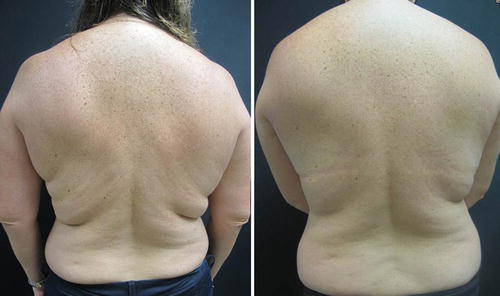
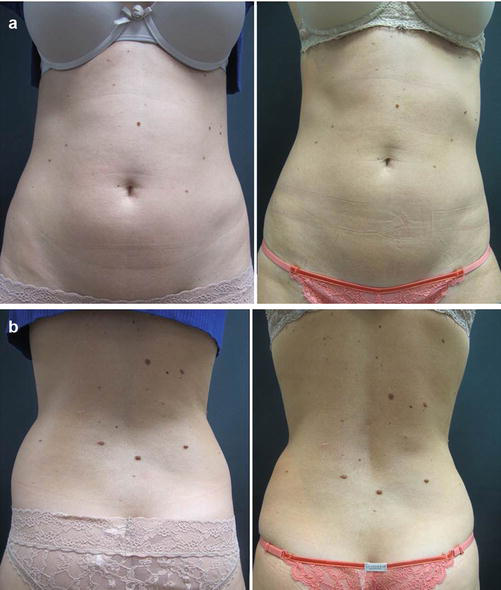
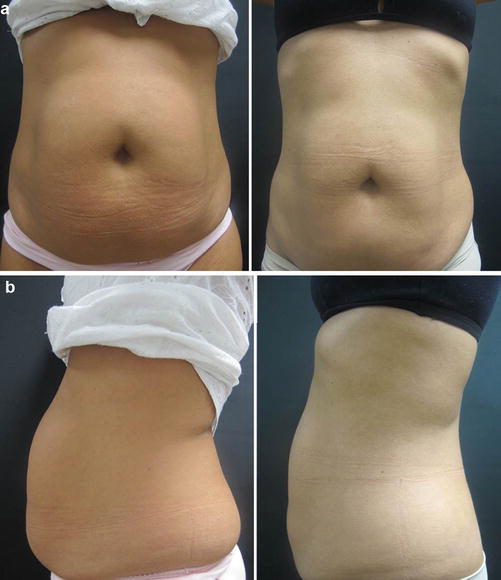
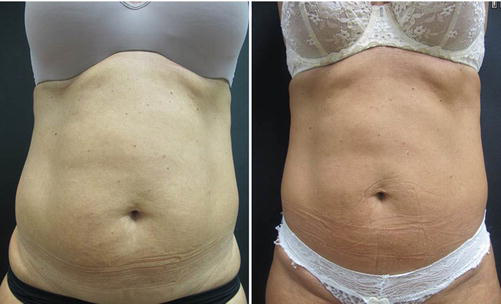
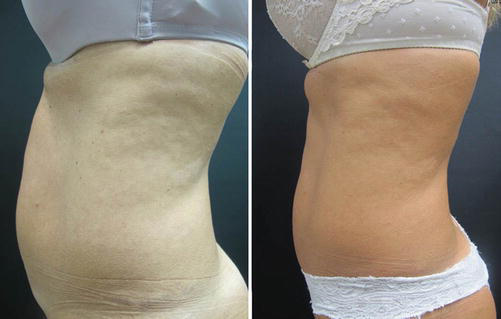
Although a fat reduction in every area examined was observed, it is still unknown which areas are the most susceptible to cryolipolysis. Various factors may contribute to the fat reduction observed after this procedure, for instance the vascularity, local cytoarchitecture, and metabolic activity of the specific fat depots (Ingargiola et al. 2015).
A subsequent treatment leads to further fat reduction; nevertheless, the extent of improvement was not as expressive as with the first session. However, one study demonstrated that a second treatment enhanced fat-layer reduction in the abdomen area, but not the love handles. The diminished effect of the second session might be explained by the fat exposed to the second heat extraction being closer to the muscle layer. The vascular supply to the muscle layer may contribute to the inefficiency of heat extraction, which does not reach the preset optimal temperature of 4 °C. Another hypothesis is that adipocytes that survived the first treatment have a higher tolerance to cold (Ingargiola et al. 2015; Munavalli 2013; Boey and Wasilenchuk 2014; Pinto et al. 2012).
Besides subsequent treatment, posttreatment massage was also evaluated to explain why this technique enhances the efficacy of a single cryolipolysis treatment. One hypothesis for the potentially improved efficacy with posttreatment manual massage is an additional mechanism of damage to the targeted adipose tissue immediately after cooling, perhaps from tissue-reperfusion injury. Histological analysis revealed no evidence of necrosis or fibrosis resulting from the massage, thus showing that posttreatment manual massage is a safe and effective method to further reduce the fat layer after cryolipolysis, with excellent outcomes (Ingargiola et al. 2015; Sasaki et al. 2014; Boey and Wasilenchuk 2014).
Adverse Effects
One of the main advantages of cryolipolysis is the low profile of adverse effects, especially when compared with more invasive procedures. Only mild, short-term side effects, such as erythema, bruising, changes in sensation, hypersensitivity and hyposensitivity, and pain, were reported in the literature. These effects can be mostly explained by the strength of the vacuum and the temperature at which the tissue is kept for extended durations and pose no threat to the patients (Ingargiola et al. 2015; Ferraro et al. 2012; Avram and Harry 2009).
Patients usually observe a red color in the treated site, which disappears in a few hours. In some cases, bruises may appear, which could last for a week. A feeling of numbness may occur in some of the treated areas. The decreased nerve sensation takes 1–6 weeks (mean 3.6 weeks), but it completely disappears after 2 months. This case of reduced sensation is self-limited and does not need any intervention. No persistent ulcerations, scarring, paresthesias, hematomas, blistering, bleeding, hyperpigmentation or hypopigmentation, or infections have been described. Swelling and bruising of the area were shown to a slightly lesser extent than erythema, but are believed to be because of the same processes. These complications also subsided shortly after (Ferraro et al. 2012; Nelson et al. 2009).
In one study, pain during the procedure was generally nonexistent to tolerable 96% of the time. Some studies showed no long-term changes to nerve fibers through nerve biopsy taken at 3 months of treatment, concluding that temperature and duration of cryolipolysis have no permanent effect on peripheral nervous tissue. Rare side effects that have been described include vasovagal reaction and paradoxical adipose hyperplasia. Jalian et al. estimated an incidence of 0.0051 percent, or approximately one in 20,000, for paradoxical adipose hyperplasia (Ingargiola et al. 2015; Jalian et al. 2014).
Histologic outcomes were evaluated in a handful of studies. No evidence of fibrosis was noted. Most studies demonstrate an inflammatory response at different stages after cryolipolysis, with inflammatory cell infiltrates peaking at 30 days (Coleman et al. 2009).
Contraindications to cryolipolysis include cold-induced conditions, such as cryoglobulinemia, cold urticaria, and paroxysmal cold hemoglobinuria. Cryolipolysis should not be performed in treatment areas with severe varicose veins, dermatitis, or other cutaneous lesions (Ingargiola et al. 2015; Avram and Harry 2009).
Procedure and Authors’ Experience
In our experience, the cryolipolysis treatment does not require preparation or restriction preprocedure. The patient should not be fasting and there is no need to discontinue medications of regular use. We advise the patient to bring a bikini or trunks to use during the cryolipolysis session.
Firstly, we perform a corporal evaluation of the area to be treated, which includes photographic documentation, measurement of the treated area, and fat percentage obtained with an adipometer.
The consent term, given to all patients, clarifies the mechanism of action, expected outcome, contraindications, and adverse effects.
In agreement with the treatment, we mark the area to be treated, in the proper positions for better aesthetic results (e.g., diamond technique in the abdomen).
When the patient’s position is suitable for the coupling and comfortable to remain during the treatment time, we apply the protective blanket with gel, specific to the device, and then couple the tip to begin the suction.
During the first 10 minutes, there is painful discomfort, which ceases due to the analgesia obtained by freezing the area. The process of freezing a tip takes about 1 hour, varying with tip type and/or manufacturer.
After finishing the treatment cycle, decouple the tip and notice the formation of a frozen “mass” with the shape of the tip (Fig. 6). The skin of the treated area should be red, slightly swollen, but intact. Erosions, blisters, or other injuries are not expected after the procedure. We should then start the manual massage with gentle movements aiming to warm the treated area.
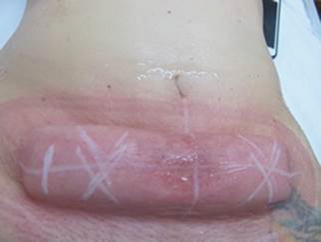
Regarding the adverse effects, we commonly observe transitory pain, erythema, and edema. Ecchymosis and nodules can occur. In our experience, the greatest discomfort is during the treatment of the abdomen. The pain is handled with oral gabapentin, which can be offered just after the procedure and sustained for 2 weeks if necessary. The edema should not be drained. Ecchymosis can last 2–3 weeks and is resolved by itself, but if patients ask for treatment, some creams containing coumarin and heparin or vitamin K can be applied until complete resolution.
There is no restriction of physical activity in the posttreatment. Also, we do not usually indicate massages as part of the treatment program. The patient is evaluated in 2 months and, if necessary, we repeat the treatment aiming at greater loss of local fat.
Conclusion
Cryolipolysis is becoming one of the most popular alternatives to liposuction for local reduction of adipose tissue. Due to its ease of use and limited adverse effects, this procedure is becoming the leading technology of noninvasive techniques as well. As cryolipolysis is a considerably novel procedure, treatment protocols still have to be ameliorated to maximize results.
Compared with the side effects of traditional cosmetic surgical procedures, cryolipolysis possesses a minor threat to patients, with a very low incidence of complications. Some studies have compared caliper, ultrasound, three-dimensional imaging, and manual tape measurements with cryolipolysis. Although no single study has compared all of these modalities, the available data suggest that these techniques have a good correlation with each other.
Cryolipolysis was first described in 2007, and although its popularity has increased dramatically, the available literature remains limited. Tremendous variability exists in study design, machinery used, and outcome measures. Due to this lack of uniformity, comparing size effect becomes challenging, and the value of a meta-analysis of the available data is limited.
Take Home Messages
- Body contouring remains among the most common cosmetic surgical procedures performed in the United States.
- Cryolipolysis is a promising nonsurgical technique for localized fat reduction and body contouring.
- Cryolipolysis is becoming one of the most popular alternatives to liposuction for spot reduction of adipose tissue.
- Cryolipolysis consists of selective damage to fat cells induced by a programmed cooling of the skin.
- Rare side effects, including vasovagal reaction and paradoxical adipose hyperplasia, have been described.
References
Avram MM, Harry RS. Cryolipolysis for subcutaneous fat layer reduction. Lasers Surg Med. 2009;41(10):703–8.
Beacham BE, Cooper PH, Buchanan CS, Weary PE. Equestrian cold panniculitis in women. Arch Dermatol. 1980;116(9):1025–7.
Bernstein EF. Longitudinal evaluation of cryolipolysis efficacy: two case studies. J Cosmet Dermatol. 2013;12(2):149–52.
Boey GE, Wasilenchuk JL. Enhanced clinical outcome with manual massage following cryolipolysis treatment: a 4-month study of safety and efficacy. Lasers Surg Med. 2014;46(1):20–6.
Coleman SR, Sachdeva K, Egbert BM, Preciado J, Allison J. Clinical efficacy of noninvasive cryolipolysis and its effects on peripheral nerves. Aesthet Plast Surg. 2009;33(4):482–8.
Epstein Jr EH, Oren ME. Popsicle panniculitis. N Engl J Med. 1970;282(17):966–7.
Ferraro GA, De Francesco F, Cataldo C, Rossano F, Nicoletti G, D’Andrea F. Synergistic effects of cryolipolysis and shock waves for noninvasive body contouring. Aesthet Plast Surg. 2012;36(3):666–79.
Ingargiola MJ, Motakef S, Chung MT, Vasconez HC, Sasaki GH. Cryolipolysis for fat reduction and body contouring: safety and efficacy of current treatment paradigms. Plast Reconstr Surg. 2015;135(6):1581–90.
Jalian HR, Avram MM, Garibyan L, Mihm MC, Anderson RR. Paradoxical adipose hyperplasia after cryolipolysis. JAMA Dermatol. 2014;150(3):317–9.
Klein KB, Zelickson B, Riopelle JG, Okamoto E, Bachelor EP, Harry RS, Preciado JA. Non-invasive cryolipolysis for subcutaneous fat reduction does not affect serum lipid levels or liver function tests. Lasers Surg Med. 2009;41(10):785–90.
Manstein D, Laubach H, Watanabe K, Farinelli W, Zurakowski D, Anderson RR. Selective cryolysis: a novel method of non-invasive fat removal. Lasers Surg Med. 2008;40(9):595–604.
Munavalli G. Cryolipolysis for the treatment of male pseudogynecomastia. Lasers Surg Med. 2013;45(S25):16.
Nelson AA, Wasserman D, Avram MM. Cryolipolysis for reduction of excess adipose tissue. Semin Cutan Med Surg. 2009;28(4):244–9.
Pinto HR, Garcia-Cruz E, Melamed GE. A study to evaluate the action of lipocryolysis. Cryo Letters. 2012;33(3):177–81.
Pinto H, Arredondo E, Ricart-Jane D. Evaluation of adipocytic changes after a simil-lipocryolysis stimulus. Cryo Letters. 2013;34(1):100–5.
Riopelle JT, Kovach B. Lipid and liver function effects of the cryolipolysis procedure in a study of male love handle reduction. Lasers Surg Med. 2009;41(S21):82.
Sasaki GH, Abelev N, Tevez-Ortiz A. Noninvasive selective cryolipolysis and reperfusion recovery for localized natural fat reduction and contouring. Aesthet Surg J. 2014;34(3):420–31.
Stevens WG, Pietrzak LK, Spring MA. Broad overview of a clinical and commercial experience with CoolSculpting. Aesthet Surg J. 2013;33(6):835–46.
Zelickson B, Egbert BM, Preciado J, Allison J, Springer K, Rhoades RW, et al. Cryolipolysis for noninvasive fat cell destruction: initial results from a pig model. Dermatol Surg. 2009;35(10):1462–70.